UFO-CONTACT FROM PLANET IARGA
POWERPOINT ON THE CASE (and here norwegian ppoint) | audiobook mp3 a/30min | part2 | 3 | 4 |
interview with this contactperson from ca 1968?- translated to engl.subtitles on youtube
Translation of Denaerde interview (or txt )part 1 on youtube | part2 | hörbuch IARGA, deutch:
https://galactic.no/rune/lydboker/2020/H%c3%b6rbuch_Iarga_planetenitaly-iarga-pdf | iarga-holland: BUITENAARDSEE BESCHAVING


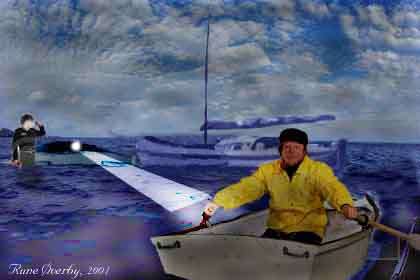
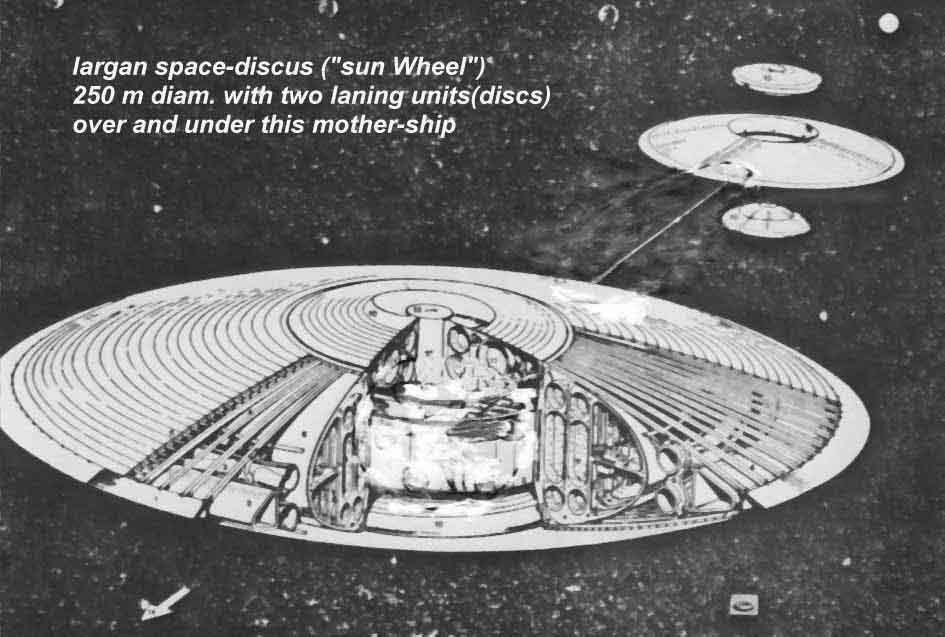
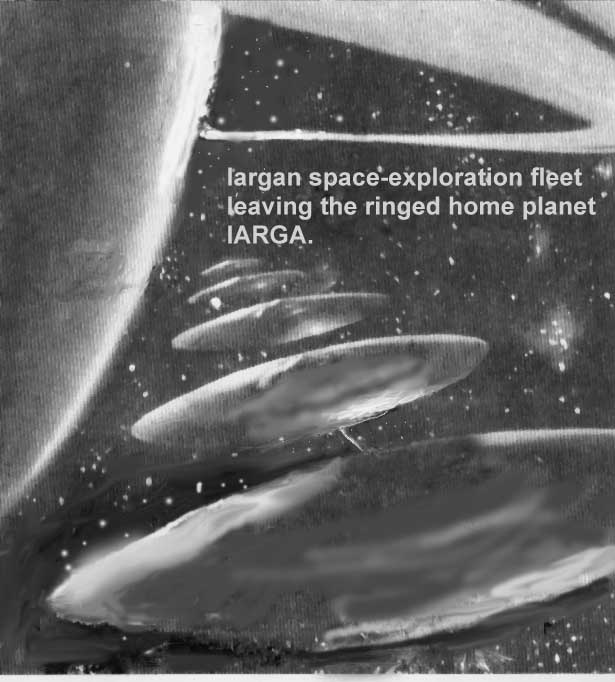
pictures made by div.artists - in center on how Stefan first saw them on their waterfloating ship, and right an idea of "them" - home on Iarga
INTRODUCTION (short introfile here)
This is a true story of a UFO contact from a planet called IARGA - by the alien astronauts visiting our Earth. They say that their Sun is about 10 light years as we count time from us, and that they have been observing us for some time.....
This story was first published in Dutch by Ankh-Hermes of Deventer, Netherlands in 1969 and has gone through 11 Editions and 40,000 hardbound copies in Dutch since then. It has been published as science fiction up to now because the publisher originally felt that this story would not sell as fact. Nevertheless it is a true account of real events and we are publishing it as such, here, for the first time, together with the very extensive follow-on data as the contacts continued right up to the present time. We have investigated this case extensively over the past 4 years and conclude that the facts do in reality verify and support the story. The witness is a very well educated and highly articulate master mechanical engineer and an architectural artist as well, a rare combination ideally suited for this contact if the alien visitors wanted their information to be understood and presented with any degree of accuracy.
The witness is also a well known multinational industrialist in Europe whose real name would be immediately recognized. He is the owner of several companies doing international business. To preserve his identity in order to protect his private life, we are using a pseudonym given him by the extraterrestrials themselves. They referred to him as "Stef van den Earde" (Stef of the Earth) from which Stefan Denaerde was derived. When I first met this man I was surprised by his size. He is a big man, about 6'4" tall and weighing perhaps 220 to 230 pounds.
He dresses conservatively in expensive business suits and is very courteous and polite. He is mild mannered and introspective by nature, and speaks with almost perfect economy of words. He says what he means and means what he says. In discussions he is not given to elaboration and volunteers little information by himself He answers questions forthrightly, directly and honestly, and looks one right in the eye as he speaks. He is not known to tell fictitious stories, but is considered to be a model of truthfulness and integrity.
He lives in an upper class quiet neighborhood in a professional suburb of Den Hague. His home, on a beautiful treelined street, looks to have a $150,000 to $200,000 value, and is well maintained and beautifully landscaped. It faces a park reserve across the street from him. The neighborhood looks scrubbed dean. This man was not a UFO buff and has no collection of UFO books and journals. He does not lecture or talk on his experience publicity or privately. He does not write articles on it or give interviews. He did not believe in the phenomena and had gone to no pains to evaluate if before his own contact. He still does not believe in UFOs as such.
His experience was real AND WAS IDENTIFIED. In the long course of contact discussions, he learned a great deal about our real history, where we have been and where we are going, and how we fit into this great universe. He found that our written histories are not very accurate because of our constant revisions by different regimes. He was shown a future course of events in store for Us if we do not change our ways, and was then shown how fixed we are in our course and the improbability that we will change in time. He is saddened and discouraged by our lack of real progress, and feels that revelation of this information is a needless and ineffective burden for a self-destructive humanity. He does not see Us changing in time! The first book, "Buitenaardse Beschaving", printed in Dutch, is an account of the contact experience up to the departure of the spacecraft the following day. The contacts continued, however, and a vast amount of technical information was communicated to the witness over the next several months and even years.
The Iargans compared their society and their philosophies to ours, and described advanced technologies, man's place in the greater universe, and what is in store for all of Us in the future. These communications continued and ultimately developed into a sort of mechanical transmission from a technical device aboard the spacecraft to the mind of the witness, something like the way it was done during his visit aboard the spacecraft in the Oostscheld, except that now the pictures were transmitted to his mind instead of viewing them on a screen. Unknown to the witness however, and this will be news to him when he sees it in print for the first time, communications experts working with NATO in defense systems had picked up a strange incoming RF (radio frequency) electronic signal in the vicinity of a high security NATO defense installation in the Netherlands, and became very disturbed about the nature and purpose of this transmission. It was in an unusual bandwidth and had a strange character. It also was only detectable within a limited area in Den Hague (The Hague near where the sensitive installation is located. NATO Intelligence, believing this may be an attempt to interfere with the defense installation and its equipment, moved hundreds of thousands of dollars worth of highly sophisticated detection equipment into the area to try to find out what was happening.
It seems that this strange signal would begin about 4:00 PM and continue for an hour or more several days each week. Now, before this information came to light, my interviews with the witness had shown that his contacts were coming in several days each week on a more or less regular basis. The witness's habit was to come home from his office about 3:00 PM daily, read his personal mail and relax in his living room for a while. Often, when he was contacted, the "telepathic" transmission would begin about 4:00 PM, and would continue for an hour or more. This strange coincidence became of paramount importance when I learned that the search for the strongest signal was taking them only a few blocks from this man's home where he was receiving the contacts!
I don't know whether they have identified the source of the transmissions yet or not, and I don't know yet if there was any other transmission that may have occupied this time period by pure coincidence. In either case I am sure that I would not be advised because intelligence information usually goes only one direction. A point of particular interest in this case is the fact that this witness was told by the Iargan visitors themselves, that their group had contacted four other Earth humans in a similar manner, and had imparted similar information to each of them, and that once one of them got into print and became known, the others would make an attempt to contact him. This will certainly be a curious validation if any one of these others do in fact turn up. These contacts are still continuing on a lesser schedule and an unbelievable amount of information has been imparted to this man. !
(As the text is scanned here - there may be some wordmistakes.The book is long ago out of print. The pictures can be some enlarged by clicking on them. Some words are translated into scandinavian in () ).
FOREWORD FROM THE AUTHOR
This book is the account of a meeting with the crew of a spacecraft from a distant solar system in our milky-way. There are many who claim to have spoken with alien beings, often resulting in strange or garbled stories, so many in fact that their credibility has decreased to almost zero. After my own experience, I think that I understand the cause of the problem. The honesty of these people is beyond reproach, but their ability as observers may leave much to be desired. These experiences take place in the zones between our normal, material method of communication, and the immaterial method that we usually describe as thought transference or telepathy. With this, the conditioning of the observer determines the quality of the reception. For example, subjects which do not affect him personally will, within his abilities, be received with the greatest clarity; whereas anything that touches him emotionally will be strongly biased or not received at all. Due to this, even a sworn statement from a completely trustworthy observer is useless, because no guarantee can be given that he knows what really confronts him.
I realize that it must seem strange for me to warn the reader of the risks involved with this type of observer when I fall into the same category, but this is because I do not want to be just believed, partly because I know why a certain group of people refuse to believe. When you have read this book, it will be dear what I mean by this. The only means of checking the credibility of the observer is logic. Due to her cosmic isolation, humanity is ignorant in certain fields, and someone who really has communicated with a super-civilization that has evolved above the material state (the minimum demand for interstellar travel), and understood them, must have access to information that is new, logical, and that can be checked in order to be convincing. As I have said, I do not seek belief, I ask my readers to be critical, but to bear in mind that the subject is so complex that it would be unreasonable to expect my story to be faultless. The content of this book is divided into two parts; the first is a description of the planet Iarga and her inhabitants and, as such, meets the demand for an identification procedure which is a mandatory introduction to all exchanges between intelligent races. The identity of a race is determined by its planet and its history, and these must be explained.
The aim of the first part is therefore purely the identification of this alien race and is not an attempt to create some kind of picture of earthly ideals, something that we should try to emulate. Iarga is different in every way. The planet and her inhabitants have a different mentality and character, and therefore a different cycle of evolution. One difference is that Iarga is almost completely covered with water. The available area of land is. spread over numerous islands with a total surface area not much larger than Australia, and according to our standards, is much too small to feed and accommodate the billions of beings needed to reach the goal of their creation. The extreme efficiency of their planning and food production methods would be pointless on Earth, and their population density forces them to a kind of over-socialized community. Only beings that posses the ability to continually improve their mentality and eliminate all aggression, have a chance of reaching perfection on such planets. We do not have this ability, the reincarnation-selection of Iarga does not exist on Earth. Here, the weeds grow up with the corn until the harvest.
Despite the vast differences, a remarkable likeness can be detected in some things; so much so that these beings can be regarded as humans that have physically adapted to life on an alien world. Their intellectual, emotional, and creative capabilities are the same as ours, and if we had been placed in the same situation, we would have become roughly the same. When the second part of this book has been read, this will no longer cause any surprise; it will have become dear that these beings are not only our cosmic brothers and sisters, but that there also exists our ego-counterpart with which we will one day be united. With the introduction complete, the real work can begin. The reason for their visit is so strange that preliminary explanation is necessary. The human race lives in complete isolation from the other intelligent races for as long as the so-called "transformation phase" continues. The plan of creation demands that we, like all others, complete the transformation phase in ignorance of our origin and our purpose. Through this we, create our individual identity and, at the same time, have the opportunity to develop our godlike talents by exploiting our creative powers and defining them, thereby earning our immortality.
The number of talent fractions is not infinite, so the time must come that the numbers of man are fulfilled. When this happens, the transformation phase will be terminated by certain external encroachments that will subjugate the will and sovereignty of the human race. The plan of creation forbids interference in the development of an ignorant race, thus the necessity for the planting of knowledge here on Earth. This knowledge appears to be comprehensive. To begin, the complete scientifically verifiable story of the creation, from the creation of time, matter, and energy from nothing; to the goal of the creation of the universe: the cosmic integration of all the intelligent races in one all-encompassing consciousness that is beyond our understanding. In this we are given a glimpse of the wonderful future that awaits Us. Beside this, a great deal of information regarding ourselves, our origin, our development, the present transformation process, the spiritual development after death, our creation mandate, and our future is given.
The first point is the most important, only when we under-stand the creation process, and in particular the development process of man, can we understand and accept the reason for the external interference that will take place in the near future. Without this knowledge the interference would be useless and therefore undesirable. Lastly, their information includes a general description of other intelligent races and their different evolution cycles, which will enable Us to approach a determination of our unique position in the midst of an incredible number of intelligent races. The fundamental reason for this book is the abolition of Earth's isolation and the announcement of the fulfilling of the numbers of man. Our first mandate was carried out in ignorance, the second will be carried out in full consciousness. The only question that remains is to what extent does this book reach its goal of removing the Earth's cosmic isolation. The question is all the more impelling when it is said that I had to give my word never to attempt to prove the existence of Iarga, because this would damage the individual freedom of mankind. I have fought with this problem for many years, until at last the problem solved itself. Even though I shall continue to avoid giving a direct answer to the question of the veracity of this story, the immensity of Earth-alien knowledge contained in this book will serve to prove beyond a doubt that the planet Iarga is not fiction, but fact.
Stefan Denaerde and W. Stevens:
CONTENT
PART I Identification CHAPTER 1 Confrontation 11 CHAPTER 2 Aboard the Alien Spacecraft 24 CHAPTER 3 Planet Iarga 53 CHAPTER 4 Iargan Society 88 CHAPTER 5 Iargan Spacecraft 100
- PART II ON PHILOSOFY link
- apendix: understanding time
- other cosmic races
- you can click the pictures and they then open in new window
PART 1: Identification
This part includes the initial contact with the extraterrestrial visitors and the nearly 8 hours of events and discussions that took place aboard the alien spacecraft as the witness was shown and experienced scenes and conditions in the life of the Iargans, both on their home planet and in their spacecraft.
CHAPTER 1
Confrontation
Iarga; I can talk about it now, the fascinating dusky green planet with its somber pink sky is no dream but-just a moment. I must first sort out the mass of information gamed during my astounding experiences and relate it logically and coherently.
I need to do this for myself as well. Any explanation of my chaotic memories may help me to become my old self gain. It is difficult for me to remember the man I used to be. How I felt that beautiful summer evening on board my yacht that drifted like a huge white swan on the windless waters of the Oosterscheld (An art of the sea in the southwestern delta of the Netherlands.)
"Hey, Dad, do you know that the compass is broken?"
I took no notice; it was probably just one of my son's childish jokes. I sat stretched out in a deck chair, contentedly sipping my coffee and surveying the distant coast of Schouwen-Duive-land (An island in the delta.) where we planned to arrive before dark.
On the small strip of land above the horizon, I could see the light that marked the harbor entrance at Burgsluis. "Honest, Dad, it's broken. Come and look," persisted my son. Still disbelieving, I forced myself to stand up and walked over' to where my wife, son and small daughters were standing looking at the compass as though they had never seen it before in their lives. Something was definitely wrong. The map was hanging at a crazy angle, but worse still, the north indicator was pointing in the direction of the Zeeland bridge, to the east! I looked accusingly at the discoverer of the trouble. It wasn't out of the question that my young son was playing a joke on his father with a magnet. I was disappointed to find that this was not the case and so I started a serious investigation. In the meantime, Miriam did the dishes and put the children to bed. By the time I decided to return to Burgsluis on the motor, it was getting quite dark, and the fact that I had been unable to find the cause of the trouble irritated me immensely. Miriam was right in saying that I should not let a compass spoil such a beautiful day, but I could not rest until I knew what was wrong. Ah well, I could do that in the harbor.

- I pushed the tjalk (an old-world, flat-bottomed sailing ship) at full power through the darkness of the Oosterscheldt. There was the light buoy. I read the number automatically and turned sharply to port. In the distance lay the next buoy, marking the channel to Burgsluis. About six miles and we would be home. But things didn't go quite the way I had planned. Something unbelievable happened.
Suddenly, out of the darkness, a strong, blue-white searchlight shone in my eyes from a point directly in front of the bow, and at the same time I heard a high-pitched whining noise above the noise of my motor. My heart pounded. It came so unexpectedly, that it must have been several seconds before I acted. Reverse, full power! Damn, it was too late! With a frightening noise the tjalk came to a standstill against something solid, but what? Who on earth would be in the middle of the channel without lights? With shaking hands I stopped the motor and in the sudden stillness saw the startled face of Miriam appear in the cabin doorway.
"Is anyone there?" I yelled over the water. In answer the light went out, but no reply. Miriam came on deck and behind her stood the children, wide eyed with fear. "Look... there... that flat thing in the water." It looked like the hull of an overturned ship or pontoon, but we were at least thirty feet away and couldn’t possibly have hit it, whatever it was. "Is anyone there?" I called a second time. The searchlight flashed on again; the strangely small beam of light swept over the water and cast a cold glare on the side of the tjalk. I caught my breath. Floating on the incoming tide was a body, face down, apparently dead. The actions that followed were carried out at nerve-racking speed. There was only one thought in my mind: to do something quickly, before the body drifted away into the darkness.
pictures not from book
Instinctively, I carried out the motions that I had so often gone over in my mind in the event of one of the children falling overboard. Seconds later, I jumped overboard with the line from the lifeboat in my hand. But what now? I was standing in less than three feet of water, and my knees and ankles hurt from landing on something as hard as steel. In my confusion, I saw the line from the dinghy drifting away. I stood up and dived to catch the rope, and, swimming with the small boat behind me, managed to grab the body. It wouldn't move. How would I get such a weight into the boat? First, tie the rope around him, climb into the boat myself and pull his head above the water; yes, that was it. Just then an alarm signal began to sound somewhere in the back of my mind. What kind of a man was this? He was wearing a kind of metallic suit and around his head was a rubbery ball which reflected the blue light so strongly that I was unable to see his face. I began to think about astronauts, but how on earth did he come to be in the Oosterscheldt? I started the outboard motor and began slowly back toward the tjalk, but what now? What should I do with this strange burden beside me? Why had I gone to all this trouble? My indecision grew by the minute.
The blue light made it plain that I must carry on. It was kept in my direction by someone who followed the rescue closely from beginning to end, but what did they want? In terrible confusion, I came at last alongside the tjalk, tied up the dinghy and stopped the outboard. In the silence, I heard the voices of Miriam and my eldest daughter. Thank goodness everything was all right there. Then my peace of mind received its death blow. There was suddenly a sea of light, a great diffused light under the surface of the water. A sound made me turn toward the strange object in the water and I saw a dark shape wading quickly toward me. It was a perfect copy of the being I had fished out of the water, with the same shiny metallic suit and a transparent ball around its head. Step by step, it came closer, and I instinctively grabbed the boat hook to defend myself. He held out an arm in a friendly gesture and turned his face toward me. I sprang back as though bitten by a snake; a wild fear cut off my breath. It was a nightmare. A terrible, indescribable feeling took hold of me. The being in front of me was not human! An animallike face, with large square pupils in the eyes, eyes which were both hypnotic and self-assured. It struck me like a thunderbolt. Here I stood, facing an alien being from a race more intelligent than my own! But why was I still so afraid? I cannot explain. If it had been a gorilla, for example, then I would have quickly sprung on board my ship and put up a fight with the boat hook to prevent the animal from coming on' board. There would have been no time for the fear that came from the feeling of helplessness in recognition of his superiority.
The fear grew into panic, a panic which told me to get away from there as quickly as possible, before it was too late! I sprang overboard again and raced through the shallow water toward the ship as though the Devil were at my heels. Panting, I pulled myself on board and started the motor. Reverse full power. I wanted to get away from there as quickly as possible. The ship didn't move an inch. Over the bow I saw the being pull the dinghy onto the dark platform, lift the body in his arms and walk away with robotlike steps. It suddenly went dark and they were gone. With a feeling of apprehension, I stopped the motor. The situation on board was surprisingly peaceful, for they had no idea of the real drama. There was a feeling of satisfaction over father's ability as a lifesaver. My eldest daughter had developed the theory that we had rammed a submarine, which was not so unlikely, considering we were dose to a naval training area. Only Miriam realized that something was wrong. She looked at me as though I were a stranger and her uneasiness grew by the minute. She had never seen me like this before. She poured me a whisky and sent the children to bed with the excuse that we had something to talk over. The alcohol did me good, but now it seemed that I had another problem: Miriam didn't believe me! "This trip is too much for you, Stef. There are no men from Mars in the Oosterscheldt." She kept talking, perhaps to try and talk some courage into both of us. I couldn't just stay inside; I had to see what was happening outside.
With a flashlight in one hand and a boat hook in the other, I stood on deck and let the beam of light play over the platform. It lay just above the surface of the water, a sinister4ooking dark-gray thing. Its diameter was about the same as the length of our ship, certainly fifty feet. It was resting on a ledge, which reflected the light so strongly that it looked like glass. In the middle was a pillar, slightly twisted, about six feet wide and eight feet high. The total size of the thing surprised me. I knew what was under the water. I could walk at least the length of a swimming pool without falling off the edge. Could this be one of the much talked-about flying saucers? Were they really so huge and could they also operate under water? I turned the flashlight out and began systematically probing around the ship with the boat hook. In front, by the bow, about two feet, and aft, about four feet. It was strange that each time I had to use force to pull the boat hook off the bottom, as though someone were holding it.
Suddenly I remembered the strange trouble with the compass-magnetism! We had collided with a huge, magnetic monster! We were imprisoned, stuck fast on a huge magnet. In the grip of strange, unearthly beings. The only possibility of escape was the plastic dinghy. In case of emergency there was room for all of us. The dinghy still lay in the same place on the platform, and in the peaceful stillness of this complete isolation a daring plan was born in me. After all, the dinghy was only about thirty feet away from me. For the third time that evening I jumped into the water, waded as quickly as I could to the boat and pulled it free. Within half a minute I was back on board with the dinghy alongside. So, that was that! I began to regain some of my self-confidence. But my uncertainty came flooding back as I heard a scraping, hissing sound. I grabbed the searchlight and shone the beam on the platform. On the edge, a sort of lid hinged open slowly and steadily. Out of the hole crawled two figures, dressed in the now familiar space suits, who pulled out some objects after them which were joined together by cables or wires. Their movements reminded me of the old-time silent films, fast and jerky. What were they doing now?
They stood on the platform and, with one hand against their ball-shaped helmets at about the height where their foreheads would be, made slow, respectful bowing movements in my direction. I understood. What a relief. It was a greeting, a friendly, respectful greeting. With quick, short paces they walked to the edge of the platform, where the bowing was repeated and emphasized, and then they stood like statues in the light of my flashlight. A strange and dramatic scene; on the Oosterscheldt a man is confronted with an alien intelligence. But the man was poorly prepared for the meeting; he was nothing more than a sailor in difficulty who could feel his legs trembling in his wet clothes. The two figures in front of me were about five feet tall and from a distance looked deceptively human-arms, head and legs, all in their proper places-but their legs were shorter than ours so that their arms reached down to their knees. Their metallic costumes were smooth and seamless. Only by the shoulders and elbows were folds to be seen. The short, heavy legs ended in broad feet that also stuck out behind, and the front part of their footwear was split in the middle. The hands were covered by supple, ribbed gloves; these were different from ours too in that not only the thumb but also the second finger was enclosed. They were heavy, clawlike hands.
A broad, gold-colored belt around each of their middles, sewn with motifs and tools, was particularly noticeable, one piece of which was dearly a hammer with a sharp striking edge. And on their right side was something that vaguely resembled a pistol. A kind of drum, wound with thin glistening thread, rested on the middle of their stomachs. The remainder of their equipment was unknown to me. I gamed the impression of immense physical strength, not only from their long, heavy arms and enormous shoulders, but also from their quick movements. The round ornaments around their heads were less transparent than I had originally thought. When the beam from my flashlight fell on them, they changed into glistening Christmas-tree balls, and only with more indirect light was it possible to vaguely make out their heads.
The silent confrontation was suddenly broken by a bud voice. "Do you understand English?" I nearly jumped out of my skin. Owing to my surprise that they could speak English, I didn't realize that they had asked me a question. The voice was totally devoid of any questioning tone. It sounded more like a statement.
"Do you understand English?" The same statement floated over the water.
"Yes, I do." "We want to thank you for the rescue of our crew member."
....... of course. Who are you?"
"We come from another solar system."
"My God," I called back. The situation was so strange that at that moment I couldn't think of anything else to say. There followed a short silence and I wondered about that strange accent which, in fact, wasn't English at all. To my ears it sounded more like Dutch, my own language. I could understand it perfectly, but I couldn't repeat a single word of what they actually said. The voice came again, and over the still dark water an unbelievable conversation began. "Is your ship damaged?"
"No, I don't think so." "Will you turn the light out?"
"All right."
"Thanks. Does the ship belong to you?"
"Have you a radio transmitter on board?"
"We would like to show our appreciation for the rescue of our crew member."
"You can do that by simply explaining some of this to me. It's just too much. How long have you been here?"
"We have been near Earth for some time."
"Why do you hide? Why haven't you tried to make contact with us?"
"Our reason is that you do not know the laws of a higher civilization."
"I don't understand."
"There is still a great deal that the people of this planet do not understand." I hesitated. How much did they know about us? "You know us well, then?"
"We have studied you for some time."
"You don't have a very high opinion of us, I gather."
"Your remark shows some insight."
"Are your people more intelligent than mine?"
"No, only more developed."
"If that's so, then I don't understand why you haven't made contact with us. You could help us."
"That would constitute a breach of the laws of nature." I shrugged my shoulders. Despite the strange situation, I began to feel more at ease. This was an unimaginably important meeting, and I began wondering how I could manage to squeeze some information out of these beings. I could learn things that man, for centuries, has only been able to guess at, and I could find out about their spaceships!
"We wish to give you something as a token of our thanks. If we give you an object with which you can prove our existence, it will surely also be worth a great deal of money. We hope that you will accept it. It is sterilized."
"What is it?"
"It is a block of inert metal that is many times stronger than your best steel and only half as heavy. It has a superconductive structure that is so straight that current can only flow through it when a positive pole is placed directly opposite a negative pole, in line with the structure of the metal. If one of the electrodes is moved only one-thousandth of an inch, the current ceases to flow. With this structure it is possible, with correctly placed electrodes, to form a spiral current pattern, the result being that when a direct current is connected to two feed wires, a supermagnet is created with a negligible current consumption. Also, the metal has a melting point much higher? than anything known on Earth. We use this metal for the outer skin of our spacecraft. That is the gift. We hope you will accept it."
I was greatly impressed. "This is incredible. I am grateful. I expected no gifts for saving your crew member, but I imagine that your intention is to help us and I accept it with heartfelt thanks."
"We admire your unselfishness, but we must point out that the block of metal represents a far too advanced technique to be of any use to you in your research. Technically speaking, it is useless, but you are right in thinking that something else is behind it. We wish to give you proof that you are being observed by intelligent alien races, who know you so well that they are able to communicate with you, but refrain from doing so. We live in the perhaps desperate hope that people exist who, with this information, will be able to understand the reason for our reluctance."
"And what is the reason?"
"You do not have the values, the ethics, of a developed civilization. Because of this, the human race has, as yet, no chance of eternal survival. It blocks the way to cosmic integration."
I shrugged my shoulders. I had never heard of "cosmic integration." They also began to irritate me. I found them a little too arrogant.
"You regard us as children, then?"
"No. An adult does not blame a child for the fact that he is not yet grown up."
"But you do blame us for something?"
"And what is that?"
"Any English-speaking Negro, Chinese or American Indian can give you the answer."
The conversation was not going exactly the way I had imagined. I had to think of something else, and at the same time be careful that the contact was not broken. I was afraid that they would climb back into their saucer and that I would never see them again.
"I think I understand what you mean. May I ask a couple more questions? This is a once-in-a lifetime experience." "That is correct. The present generation will not have the chance again."
"Answers to my questions seem to me to be much more important than the block of metal."
"Your insight surprises us. The answer to carefully selected questions is certainly much more important."
I was surprised that they agreed to my request so quickly and easily; they suddenly seemed much more friendly.
"In that case, I would like to know what your spacecraft looks like, and, more important, how it is powered."
"You disappoint us with this question about technical knowledge. The most dangerous natural law governing the development of an intelligent people states: a highly technological society does away with all discrimination or self-destructs. To supply technical information to a people like yourselves is a serious crime against the cosmic laws. The last thing that you need is technological information to increase the gap between your intellectual development and your almost nonexistent social development. Carry on playing with your Mars 'probes for the moment, as half of your world's population lives in poverty and hunger. The only information you need lies in the field of societal standards."
I was terribly disappointed. There went my dream of learning breathtaking technical discoveries.
"I am afraid that very few people would be interested in that kind of information."
"We are afraid so too."
"When do you think that the time will be ripe to give us information about space travel?"
"The cosmic isolation of an intelligent race can only be lifted when the minimum culture level has been reached; we call it 'social stability."
"Hmm... and this conversation, then?"
"We feel ourselves justified, because of your actions, in supplying certain small pieces of information which will set the present generation to thinking."
"What do you call a socially stable culture?"
"We could give you the answer, but we doubt that you would understand it."
"I will take that chance. It seems to be important."
"Be sure that you know what you want. This answer demands an explanation in word and vision for at least two days. Furthermore, you must choose between the material gift-the block of metal-and the immaterial gift in the form of information. We cannot give you both."
"I don't understand what one has to do with the other."
"There is still so much that you do not understand, but after our explanation, this question will also be answered for you.
"Are you really prepared to spend two days explaining this to me?" My tone dearly showed my surprise.
"We are, for at least two days. A conversation of shorter duration would have no point; it is the minimum time in which we can give you the necessary information. We have all the time in the world-space travelers are never in a hurry-but we must warn you: we doubt that the information that we will give you will make your life happier, so be sure that you know what you are doing."
I shrugged my shoulders. It was dear to me that these beings were devious, but I did not intend to let this one chance in a million slip through my fingers.
"All right, what do I have to do?"
"We have a small, sterilized decompression chamber, and only from there will you be able to hear us and see our screen. Food and drink you will have to bring from your ship, which should stay here. We must warn you again: you will become wiser for this experience but not happier."
"We can leave with our ship whenever we want, right?"
"Naturally, but if you leave us it is for good, and with our blessing. All we ask now is a solemn vow from you and your wife that as long as we are here you will not contact anyone else and will do everything in your power to keep our presence a secret."
"I need to talk it over with my wife."
"Naturally." But my decision had already been made. I will not tire you with Miriam's arguments, nor with the latter part of my conversation with the aliens, which consisted only of a number of instructions regarding anchoring, lighting, knock signals and so on. The visit itself was to begin early the following morning, for which preparations were needed.
The two statues turned about and, laden with their apparatus, disappeared as quickly as they had come. As if sleepwalking, I went slowly to the bow and, as agreed, let the anchor fall onto the hard metal bottom complete with an extra piece of chain.
Soon afterwards the platform sank with a bud zooming noise under the surface of the water. A dull shock followed and the ship floated in its element once again. A short time later my brain received yet another jolt. The dead stillness of the night was broken by a terrible noise, a bud zooming combined with the screaming, howling tone of a circular saw. The anchor chain jerked tight and the surface of the water became strangely disturbed. The spaceship was acting as a submarine. We were pulled forward over a broad foam track which was lit from beneath a dull yellow-green light. The noise was unearthly and frightening. I stood, fascinated, and began to wonder what I had let myself in for.
CHAPTER 2
Aboard the Alien Spacecraft
"Good God!" Miriam's exclamation so early in the morning reflected both surprise and repulsion. In answer to my repeated knocking signals, the huge, round platform had risen again above the surface of the water and now, in broad daylight, the sight was much more impressive. The slightly domed platform lay, just as it had yesterday evening, with its edge level with the surface of the water. Its surface was for the most part as smooth as polished stone and dark gray in color with scattered patches of off white which made it appear as though someone had been throwing around bags of flour. Over this otherwise perfectly smooth surface ran innumerable ragged, charred grooves which ended in a small crater, as though something had exploded there. Nearly all the scratches and grooves ran in one direction and gave the impression that the spaceship had been grazed by enemy fire or that someone had been at work with a blow torch. All in all, it was an ominous sight, and Miriam's reaction was not very reasoning.
"Stef, please don't go. Something as alien as that can only spell trouble for Us all."
She was right, of course. There was something wrong about entering this thing, but even the latent fear from last evening and the leaden feeling in my stomach brought on by the sight of this forbidding platform were not enough to hold me back. A few moments later I was sitting on the edge of the platform, drying my feet after wading through the water, I donned my shoes and socks and, armed with sandwiches, thermos and note paper, I began to look for the opening that they had described. I had hardly taken a couple of steps when a round, safelike door slowly began to open near the edge and a small quantity of sand and water which had settied in the jomt was blown away by a stream of compressed air. I went closer and looked down through a round hole, about three feet in diameter, into a cubeshaped space about eight feet across. Once again, I heard the voice.
"Welcome on board. Be careful as you come below. The ladder is dangerous for you."
Indeed, the "ladder" was nothing more than a pole with staggered steps on either side formed to place my feet. I stopped in my descent and waved to Miriam, saying, "Don't worry. I'll be back around five o'clock. The reception has been very friendly, and it's really quite cozy in here."
Once below, I cast my eyes around the room. Unimaginably complicated equipment lined the walls and the ceiling. The only things that were vaguely familiar were huge reels and drums, wound with every possible size of cable and pipe. In the floors was a metal door that looked remarkably earthly, with a round knob in the middle over which I nearly stumbled. In one corner stood a kind of desk with rows of knobs, and above, a panoramic screen, about five feet long and three feet high, that glowed with a soft green fluorescent light. Behind the desk stood a strangely normal-looking chair with a metal frame and leather upholstery.
The voice invited me to sit and explained that the seat had unlimited possibilities for adjustment but that certain instructions from the voice would be necessary before I could be comfortably seated. "Yes, thank you. What happens now?"
"Introductions would seem to be the best way to start. Will you answer a few questions?"
"Yes, of course."
"How should we address you?" "Call me Stef."
"All right, Stef. The language we speak is not your own language, although it seems to be. It is the language of all living species in this universe. Even a plant or an animal will understand it. This language was spoken on Earth before the Babylonian confusion of tongues. You don't hear words but sounds that are directly reflected by your emotional structure, the life-field. Therefore, don't try to understand words, but listen to the reflections of your soul."
"Is that a kind of thought transference?"
"Not exactly, but you can compare it with that."
"I understand."
"How old are you?"
"I am forty-three."
"Are you in good health?"
"Yes, perfect."
"Have you a high social function?"
"High? What do you mean by high? I am the director of a business with a few hundred employees."
"So you are a representative of the directing class of the Westblock?" (husk møtet skjedde på 60-tallet)
"I don't quite understand the question. What do you mean by Westblock?"
"Let Us ask, then: are you a supporter of a free economy?"
"Yes, without a doubt."
"Now it is your turn. Would you perhaps like to see Us from dose up?"
I tensed involuntarily, and my heart began to beat faster. "I am afraid that I will get a shock if I see you."
"That is true. Nothing is more intense than a visual confrontation with another intelligent race. Do you feel strong enough not to panic?"
"Now that I know that I have nothing to fear from you, I will not panic."
"You certainly have nothing to fear from us; on the contrary, we are indebted to you. Look through the window to the right of the screen. When we turn on the light, you will be able to look into our navigation room. Ready? Right, then, here we go."
I looked into a huge, round chamber, about forty-five feet across and nine feet high. From the decompression chamber I could see over the greatest part of the navigation area, with its vast contents of instruments and control panels. Strangely, all the instruments and panels were mounted on the floor with walkways alongside and separated by vertical metal grills that reached the roof. Everything was dark blue in color, almost black, causing a very strange lighting effect. The dominating blue-black surfaces acted as an almost invisible background against which all the white or polished metal knobs, handles and instruments stood out in dear relief as though luminous. The encompassing vertical wall of the dome looked as though it was made of glass; the highly polished material reflected strongly and gave a very strange lighting effect from the reflections. On many of the panels diversely colored lights burned, interposed by dark transparent strips on which flashes or darting lines could be seen. An imposing piece of technology. I suddenly realized that there was no sign of life whatsoever. "Well, where are you, then?"
"Prepare yourself. You may see Us now." A light came on illuminating an area directly in front of the window. I sprang back! In spite of my mental preparation, the paralyzing fear had returned quite suddenly and cold shivers ran over my scalp, through my neck and over my shoulders. On the other side of the window, in a half circle as though at a conference table, sat eight strange humanoid beings. Their faces and forms radiated as much primitive animal power as haughty intelligence superiority. I felt again the uncertainty of yesterday, a reaction to their obvious superiority and self-assurance. I am convinced that any intelligent man would have felt the same, and that this reaction is a part of our makeup. The same feeling that I did not belong here, that even these steel walls could not protect me from the mental impact made by this intelligent "pressure group" from a much higher level of civilization and development, with their fantastic knowledge, belonging to a strange, distant world. Their unearthly, somewhat animal, faces, with a dynamic expressive ability, emphasized the difference in our places of origin to such an extent that I am convinced it touches areas that to Us are still taboo, and which have been since time began. When you are unable to draw, how on earth can you expect someone else to draw a face that he has never dreamed existed? How can you create a portrait with words? My friend, Rudolf Das, who accepted the task of drawing the pictures of this book, was driven nearly to distraction by my dubious attempts to produce a good likeness, one which would demonstrate their superiority. He finally convinced me that even a photograph would not effectively convey what I had in mind. The facial expressions must be left, unhappily, to the imagination of the reader.
It was the hypnotic effect of their eyes, with their large, rectangular pupils) that made the deepest impression on me. They were the thoughtful, peaceful eyes of deep philosophical thinkers that were studying me with quizzical friendliness. Their heads were about the same size as ours, only slightly deeper toward the back; and in the middle of the skull was a bony ridge that changed into a deep groove in the center of the forehead. It gave the impression of a skull divided into two separate compartments. Toward the back of their heads the ridge ended in a semicircular muscle formation that ran down the neck and into the shoulders, making the side view of the neck much heavier looking than ours. The same is true of the whole construction of their bodies. They were much more solidly built than we are. Their arms and shoulders, although of much the same proportions as ours, were much heavier and more muscular and, combined with the clawlike hands, gave an impression of strength that would have come a dose second to a bench vise. All this combined with their broad chests and short stocky legs made them look as though they would not even step out of the path of a gorilla!
Their muscle tissue also seemed to be different, more like solid rubber, and their thin skin followed the contours of their muscles more closely than ours. The top of the head to the back of the neck was covered with short, smooth hair that shone like the coat of a smooth, furry animal. The color of this hair was different with each of them; rust-brown, gold and silver-gray showed either separately or mixed. Their hairless skin had a pale, glasslike sheen to it. Along the edges of the face the skin showed slightly darker gray-brown than in the middle. As they turned their heads, the skin seemed to reflect the light and shade of their surroundings. This changing color effect was something that caught my attention many times. Their teeth were two seamless white strips, above and below, that closed in a scissorlike fashion. Both their teeth and the yellow-white of their eyes reflected the strange lighting in such a way that their faces looked slightly artificial. Their movements were also strange.
They could sit or stand perfectly still for much longer periods and more often than we would even attempt, but when in action, their movements were lightning fast and emphasized their tremendous strength. They were like volcanoes. After a period of rest, they would erupt into a wave of energy and temperament that would have made a Spaniard jealous. They were wearing a kind of uniform in the form of dark-blue, silky overalls, with three-quarter sleeves and a deep V neck. Under this was a white shirt with a rather old fashioned high collar around the back of the neck. Around their waists was a broad, gold-colored belt, decorated with what seemed to be atom formations, which ran along the edge of the deep V in the neck as well, incorporating, however, still other motifs in its design. (cont.under)
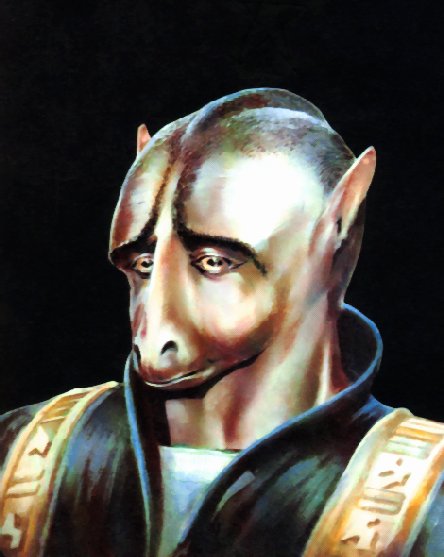
The following is text for the picture of the humanoid from Iarga: Humanoid from the planet Iarga, which is a little more than ten light-years away from Earth. Although these beings have the same origin and identity as man, and their physique is comparable in many ways, there appear to be many great differences which result from the different planetary conditions. Their planet is larger, the gravity is nearly 3g, and the atmosphere pressure is more than 7 bar with higher nitrogen and ammonia contents than our air. The average wind speed is less than ours; but the denser atmosphere in combination with heavy rains and the higher terminal velocities, sometimes cause storms that an unprotected human could not survive. To withstand these conditions, they have a short, compact physique with well-developed muscles, especially the legs; armored skulls, and deep-set eyes. Their darting movements are interposed with periods of rest, during which they only move their heads. They walk stiffly, with short steps, as if they are walking on ice.
They were originally amphibians, and really belong in the water. Their bodies are as streamlined as that of a seal, and are covered with short smooth hair, like an otter. Their hands and feet are large and broad, and they have webs between their fingers and toes. We could not possibly compete with them in a swimming race. They are capable of killing a small whale-sort by ramming it like a torpedo, a group will then tow the catch back to the shore. (swimming).
Their sex drives are different from ours, and they find sex less important; partly because they derive less pleasure from it than we do. The population growth is slow, and they lack the sex signals of humans, such as full lips, ear lobes, pointed nose, protruding female breasts and the external male sex organ. This is why it is not necessary for them to cover their bodies as we do, their reproduction impulse is born of love and not lust. We seem to be abnormal in this respect. Their weak point is the development of their individuality. They do almost everything in groups (tribes), they think collectively and they obey the laws of their society to the letter. They live for and through the friendship and love within the group.
cont. from above: .....I decided to end the silent confrontation. "I'm sorry that it's taken so long to get used to the sight of you."
"We have only compliments for you. You have remarkable self-control. You demonstrated the same quality with your rescue of our crewman, for which we would once more like to offer our thanks."
"Oh, that was nothing. When I see all the technical capabilities at your disposal, I wonder if my help was really necessary?"
"The value of an unselfish deed cannot in any way be influenced by asking afterwards if it could not have been done in some other way. As a matter of fact, your help came so quickly and efficiently that it would have been impossible for Us to have managed it in a shorter time. It was precisely this speed and efficiency that gave Us the idea that you could possibly be a man with whom we could communicate, the first communication with a representative of this world. Make sure that you realize what this conversation will demand of you. You will be speaking with a race that is far ahead of yours in evolution. This means not only an enormous technical lead, but also the same lead in mental development and inner culture. This last is the most difficult to explain and yet we must make it dear if you are to understand what social stability represents.
"We will therefore lead you, step by step, through the secrets of a highly developed culture, and we will do this by means of a holographic film which will take you to our planet Iarga. We will let you see what the world 'civilization' really means. It will be an interesting experience for you, the value of which is impossible for you to judge at this moment. But what you also cannot judge is the personal danger involved. We know the dangers and will protect you against them. The most important thing for Us is to ensure that your freedom of thought is not damaged. Freedom of thought is the essence of humanity, and if we were to damage that we would, according to our ethics, be committing a crime. Therefore, we will only convey knowledge to you, and not convictions.
"We wish no discussions. We will only answer questions when you do not understand something, and we will remain silent when you do not agree with Us. We will help you to climb the ladder of knowledge, rung by rung, first to social stability, then to the super culture and, if you can follow this, to the misty heights of cosmic integration. "We will only give you knowledge. You must remain free to do with this knowledge what you will. If as a result of this knowledge you should find yourself forming any convictions, do so with care. Make sure that they are lasting convictions, born of independent creative thinking, and not the sort of passing convictions that the impact of strenuous visual emotions tend to provoke. These pseudo convictions paralyze individual freedom and make men rigid and dogmatic.
"Knowledge is a material part of the human condition and, as with all material things, it can be mechanized or automated. We have at our disposal a method of teaching that utilizes a certain type of radiation. This takes place at a speed of which you never dreamed. Above your head we have fitted one of these radiation reflectors. It makes the spoken word unnecessary to a great extent. On the screen in front of you we will show our explanation in the form of a picture story, the words of which serve only to direct your attention in a certain direction; we call this fixing the concentration, but the true source of information is the radiation. You do not have to take notes; information gamed through radiation remains locked in the memory forever.
"Experience this adventure with an open mind. Anything else will disturb your concentration. Do not become angry if we say something that goes against your principles. We have no intention of antagonizing you. If we do so, understand that it is purely a result of our ignorance regarding the many taboos and prejudices of western man."
They started the radiation device working with the film. At first I was not quite sure what was happening. I felt cold and somewhat lightheaded suddenly, a feeling comparable to having had a little too much wine. You believe you can think very dearly but you feel somewhat removed from reality. The fantastic film projection was accompanied by a rather childish description of what was to be seen. Now and then a few words brought my attention to the size of something-the height, the speed, the form or the connection between two things, and so on. An endless stream of words and short sentences formed a slender thread of explanation. The essence, the real information, reached me unnoticed, and that was a weird experience. The knowledge that these beings, through their machine, could feed information directly into my brain, strengthened my feeling that
I did not belong here. The difference between Us was too great. I was defenseless. As far as I can gather, radiated information is a combination of visual stimulants and thought transference, all of which takes place at fantastic speed. The images came in such rapid succession that at first it made me irritable, and only after some considerable time did it become dear what was expected of me. I had only to act as a relaxed spectator, who observes with interest what is happening; they did the rest. It is understandable that this type of information is not suited to the written word and therefore I have attempted to relate everything in the form of a two-sided conversation. This tends to give the impression that I was a partner in an animated discussion, but nothing is further from the truth. My function during this meeting can be compared with that of a tape recorder. The authenticity of the hologram was so fantastic that it could no longer be describe as a picture.
As long as I kept my head in the correct position, it was just like looking through a window. The three-dimensional, panoramic, color screen offered so persuasive an illusion of reality that after the first few minutes I looked behind the screen to make sure that nothing was there. The adjustment of the picture was controlled by several of the many knobs and handles on the desk in front of me. My first experience with the radiation took the form of knowing, without further instruction, which of the knobs I had to use to adjust, for example, the focus or the position of the picture on the screen. The test card, a jungle of vertical stripes, vanished and I looked into a great, black hole in the middle of which hung a blinding ball. I recoiled involuntarily, at which the picture blurred, but I quickly got control of myself. The hole was very deep; I was looking into the endlessness of the cosmos. Against the black, somewhat violet background, sewn with thousands of stars, a gigantic, pink-white ball hung in stately beauty. The planet Iarga.
The sight was very moving. I felt as through I was really present in space and a strange emotion began to flow through me. The cloud formation was, in contrast with that of Earth, unbroken, with small, swirling patterns that caught the sunlight. The pink patches occurred where the sun was able to penetrate deeper into the clouds. Most remarkable were two gigantic, flat, concentric rings which formed a halo around the planet. They were rather like the rings of our Saturn, except that these consisted of a small inner ring and a much broader outer ring, both casting a sharp band of shadow on the clouds. There was also a large moon to be seen, with the same pockmarked surface as ours. Iarga, the home of these astronauts, is a planet in another solar system, not much more than ten light years away from US. More details of the location of the planet they would not tell me. The diameter and mass are much greater than the Earth's; the gravitational force is greater and the atmosphere is much thicker. The speed of rotation is much slower than that of Earth, so that the duration of day and night is longer, but the regular tilting of the rings around the planet change certain days into nights and certain nights into days, due to the fact that the rings reflect the sunlight.
As a result, Iarga does not have the regular pattern of day and night that we know. Because of the thicker atmosphere and higher air-pressure, which is of a different composition than ours, Iarga knows no bright sunlight, and sees nothing of the moon or stars. A permanent layer of mist exists at the higher levels of the atmosphere which filters the sunlight. The color blue only appears in lighter tints and green is more pronounced there than here, which may account for the fact that they seem to have a preference for blue in their artificial lighting. They describe the Earth as the blue planet with the blinding light, and, in contrast, Iarga as the green planet with the misty light. The living conditions are very different from those on Earth. Temperature extremes are much less than here, but when you hear that the wind speed can reach three times our maximum, and that ram and snowfall can be as much as ten times greater, and you combine this with the fact that the terminal velocity is much higher, it becomes dear that it would be very unwise for any of Us to be caught in a rainstorm on Iarga! After being informed that a fall from a height of six feet was fatal, I began to understand a little more of the reason for the physical appearance of these Iargans.
The rubbery muscle formations, armored skulls and long arms were products of very different climatic conditions than ours. There earthquakes also seemed to occur with more intensity and frequency than ours. Just as I was beginning to ask myself what the buildings on such a planet would be like, the picture changed and showed the view from a fast-moving spaceship that had just passed through the outer layer of mist around the planet. Initially, I saw only clouds: above me, the pink layer of mist that I had seen earlier; then a second, broken cloud layer which was primarily responsible for the strange, diffused light on the planet. We passed through this layer at a height of about twenty miles, and viewed from the underside it was a mixture of yellow-gray, brown and greenish clouds that gave a very somber and threatening impression. Lastly came a cloud layer that in height, form and color, closely resembled ours, and after passing through this, I had an unobstructed view of the surface. We flew over a bright-green ocean with white wave crests.
Above the water ran an orange strip as straight as an arrow, which, separated by a white-beached horse-shoe-shaped island, split and continued in different directions. It was only when the spaceship came steadily lower that I realized what this strip was. A railway bridge! On long, slim towers, high above the water, ran a bridge as far as the eye could see. Along this bridge slim shining torpedoes moved in both directions. Their speed was only slightly less than that of the spaceship and there were far too many of them for me to count. The distance between the torpedoes was about ten times their own length, all spaced exactly alike along an eight4rack system which was divided into two layers, one above the other. I had little time to study the trains further, for we moved on.
Land came into view - a low-lying coast, split by a broad river with large adjoining lakes-and before my astonished eyes a strange, unearthly panorama unfolded. For as far as the eye could see, the land was divided by the orange railway into regular rectangles. The long torpedoes moved between huge, glass, oiltank like constructions with shiny dome-shaped roofs. Areas of green on either side of the railway looked something like prehistoric forests. The longer I studied this landscape, the more I became aware that this was ribbon development in its extreme form. The area between the buildings seemed to be used namely for agriculture, only now and then making way for an industrial complex. The camera sped on. The landscape changed and became undulating, split by walls into huge terraces which compared with the wine fields of Italy. Behind this lay mountains, and in a great bowl between the peaks a red-brown lake came into view. The machine tilted its nose steadily lower until I was able to see vertically below. Around the shores of the lake, numerous buildings were to be seen, among which were several gigantic combs.
In three places, powerful blue-white lights, flanked by orange lights, flashed. Everything pointed to the fact that the spaceship was going to land here, and just at the last second, before the picture vanished, I saw something that made me catch my breath. On the right side of the screen, low above the lake, three shiny discs hung like sentries in the air. They had the form of perfect, streamlined discuses. "I saw flying saucers!"
"You saw three of our aircraft."
"In the form of a saucer?"
"Exactly. And if you are interested, we will let you see them."
"I certainly am. Did you come here in something like that?"
"No. These aircraft have about as much in common with our spacecraft as an Indian arrow has with your Mars probe. We hope that you have more important questions to ask than about aircraft."
"Of course. Am I to understand that the glass tanks are your houses?"
"Yes, We call them house rings because they are in fact built in the form of a ring with a covered central recreation area."
"Is the whole planet built in this way?"
"Yes, all areas that are suitable for living are built in this manner." The screen showed a view of a living area from a great height."
"So you all live in the same type of house?"
"From the outside they are all the same, but inside there is great variation."
"The uniformity appalls me. Do your top men also live in the cylinders?" I had an idea, judging from the length of the trains, which I guessed were about one hundred and fifty feet, that these buildings were enormous, at least nine hundred feet in diameter and more than three hundred feet high.
"The words 'top men' suggest something of the Earth's ideas of status; you surely do not imagine that in a higher civilization, standards of justice can exist that allow status to play a part?"
"I don't see what status has to do with more variation in house building. Why not simpler, smaller houses with more privacy?" "Small houses with separate pieces of land form a system that you call 'towns,' and such inefficiency is unthinkable to Us. "Why inefficient? When you have our problem of overpopulation, you must build large cities to house all the people. We cannot afford the luxury of large areas of woodland as you can."
"What do you call overpopulation?"
"Our small country has more than three hundred people to the square kilometer, which in my opinion is quite dense." "Compared to Earth's average of twenty-five to the square kilometer, that is indeed dense. Estimate the number of people living in the area that you see here. Every ring houses about ten thousand. Work it out per rectangle."
"Ten thousand per ring?"
"Yes, and we have more square meters per person than you have." I did a quick calculation. Each rectangle contained thirty-six rings, so thirty-six times ten thousand is . . . heavens! Three hundred and sixty thousand! I hadn't expected that. It made each rectangle a complete city! But, then, it was also a lot of land. "How long is the rectangle?"
"Roughly ten kilometers." I judged that the width must then be in the region of six kilometers, so that an area was then sixty square kilometers and therefore my solution must be 600 people per square kilometer. "I was certainly mistaken about your population - 600 per square kilometer. That's double ours. I was under the impression that it was much less. When I see the space that you have left, I must admit that it is a very clever solution."
"Your answer amuses Us because you have made a small mistake. You have the decimal point in the wrong place." I calculated again and came to the ridiculous total of six thousand. "It can't be six thousand."
"It is, Stef. What you see here houses a population of six thousand people to the square kilometer."
"But that's ridiculous. How can you do it? That's twenty times as many as our overpopulated land."
"Your word 'overpopulation' is pure nonsense. Our planet has a population density at least one hundred times greater than yours and we do not speak of overpopulation."
I began to feel uneasy, that was madness. I knew it. I should never have started this conversation. It was leading nowhere. I stared with new interest at the picture in front of me and tried to calculate the living space of these people. Strange as it may seem, there were no signs of overpopulation. On the contrary, there was room enough, round the cylinders, and the roads that ran through the woodland areas were in no way obstructed with people or traffic. "This is so incomparable with anything that we know that I am at a loss for words."
"That is the right attitude. With this confrontation with a totally different world, with totally different standards and a totally different philosophy, we are trying to make it dear that you must not draw comparisons. Doing so prevents you from understanding this world and its level of civilization. Forget your own world and try to understand what is happening here. Try, without prejudice, to follow our explanation, as this alone will be difficult enough. "The reason for our dense population is the small area of dry-land on our planet. Iarga is almost completely covered with water forming deep oceans, which leaves Us with a surface area of dry-land which can be compared to the area of Australia, and this is distributed over numerous islands. We were faced with the problem of feeding and housing the billions of beings which we needed in order to achieve our creation goal, on the smallest possible area of land. This imposed the greatest demands on our planning and social systems; these demands do not occur on Earth, you have room to spare.
"What we needed to create a high level of culture were three things: freedom, justice and efficiency. We will explain these concepts one at a time, beginning with the last, efficiency. "You are shocked by the size of our population, but the space surprises you. Strange, eh? It is not so strange when you realize that you are not shocked by the number of people but by the space that is left over in what to you is a ridiculously overpopulated world. You are shocked by our efficiency. To Us, it is the most normal thing in the world, because without this concept, we simply could not exist. Without efficiency, our world would immediately collapse. You will continually come up against this concept in our explanations because we must make it dear to you how carefully each of the three concepts-freedom, justice and efficiency - we had to employ to reach the level of civilization that can be called stable. "Also, justice is a condition for efficiency.
For example, if houses play a part in showing a difference in status between people, then justice fails, and efficiency in a setting such as this is impossible. It demands, therefore, a different, more social way of life." This was roughly the beginning of the explanation of the concept of efficiency, and I absorbed it with some difficulty. Who would expect the description of a super culture to begin with a lecture on efficiency? Anything but that! And it is almost impossible to relate just how efficient they were. Take, for example, their method of planning. It is simply based on the maximum number of people that a given land-area can accommodate. The housing and the roadways take up the smallest possible area-not more than five percent-in order to leave a maximum of land for farming and natural beauty. The farming areas produce the maximum in food that their technique allows, in order to support their huge population. The woodland areas are necessary to maintain a sufficient quantity of oxygen in the atmosphere and also serve as recreation areas. Everything is used to maximum advantage.
What would you imagine to be the mode of transport of a super culture? You think perhaps supersonic aircraft or rockets, and hovercraft type ships or hover-cars? Out of the question. Anything so inefficient, with so many moving parts which can wear out and require so much maintenance, would be madness on Iarga. What do they use, then? Very simple. A fully automatic, robot rail system. Slim torpedo trains that move without creating friction, the only component requiring servicing being the doors, and these are made of such a high quality that they can last at least one hundred years. As a well-brought-up Earth man, I didn't give up too easily and pointed out that our aircraft, so fast and comfortable, were surely much better than trains that can only reach a speed of about four hundred kilometers per hour. I got the most surprising answers. An aircraft is not only inefficient but is downright antisocial!
They only appear on a planet where status still exists, and they are only for the upper classes, because they are useless as a medium of mass transport and the cost per passenger-kilometer is at least ten times that of their rail system. They began to talk about transport capacity. The six-lane rail system between the house blocks (only the upper layer) can transport one million persons per hour operating at maximum capacity. Did I think that aircraft could compete with this?
No, I did not. Confronted with such astronomical figures as these, further argument is pointless. They were not yet finished. Did I really think that their transport was slower than ours? Yes, I did get that impression. Well, I was very wrong. I must think in terms of average speed, and the hours that we wasted waiting for connections, delays caused by unservice-ability or bad weather and our wonderfully inefficient trafficjams! Having thought of all this, I was readily prepared to believe them when they said that their average speed of all transport systems together was about five times higher than ours - inclusive aircraft. Had I mentioned something about comfort? Yes, I had.Wonderful, because comfort was also an aspect of efficiency. Trains had proven to be the cheapest form of transportation, and the only problem that remained was to get as many people as possible to leave their cars at home and use the tram. The only way to do this was through comfort, and this comfort was really something.
These trains were shock free and silent, apart from wind noise. Due to their position high above the ground and their large windows, they offered a breathtaking view of the surrounding countryside, and the interior was so luxurious that it left nothing to be desired. They were unaffected by weather conditions and one hundred percent reliable. The frequency was so high that timetables were unnecessary. Did I now know enough? Absolutely not! It had gradually become dear to me that their understanding of efficiency was totally different from ours. It influenced their very souls. Efficiency had become almost a religion. One of the most imposing visions on the screen was their trans-oceanic rail connections. A wonderful, orange-colored construction, about seventy-five feet above the restless green water, crossing the ocean in a dead straight line. I thought at first, perhaps a little naively, that the support towers stood on the ocean floor, but no-nothing so primitive. The whole construction floated, supported by huge balls under the towers which were anchored to the sea bed by adjustable cables.
The balls were placed at a depth where the water always was comparatively peaceful, unaffected by the conditions on the surface. The question that intrigued me was how the trains could function without friction and wear. I discovered that it was not so difficult once superconductive materials and supermagnets, the same sort of materials that were used for the outer skin of their spaceships, were used. The train was supported on magnetic shoes over its whole length which ran in a hollow rail. Through the polarity and the strength of the magnetic field, the shoes were held floating in the middle of the rail. A fantastic piece of construction. The system was controlled from large electronic control centers and was almost fully automatic. Optical signaling was not used, so that the speed was unaffected by even the thickest fog. Their cargo trains intrigued me the most, for they were in fact nothing more or less than self-homing containers. The route program was plugged into the nose of the unit and the ghost train left on its journey without a living sour on board, finding its own way over the rail network to its destination, silent and vibrationless, and without lighting at night.

Some things were rather amusing. There seemed to be a rather popular pastime that they called traveling in hotel trains. A group of about twenty-five people would order a unit that was fitted out as a self-service hotel and simply go where the mood took them. Everywhere in the beauty spots were "campings," where the trains could stay for a couple of days or more, and all you needed to do to travel further was to program the unit for its next destination. Traveling this way, often at night, they could cover enormous distances. As soon as I asked a question that fell outside the program, I received more of their strange answers. "Can everyone afford to go on in this way?"
"No, nobody can afford it, because we have no money, but everyone can go on holiday in this way if they wish."
At my request, they showed me one of their cars. In front of one of their huge, glass living cylinders stood a highly streamlined vehicle on ridiculously small wheels; nevertheless, it could be classed as a motor car. My enthusiasm for motor cars was suddenly diverted by the sight of two Iargan women who, accompanied by four small children, were to demonstrate the car. I sat staring at those strange exotic beings so intensely that the explanation about the car was for the most part lost on me. Their faces were smoother and finer than the astronauts' and they were made up with white and purple stripes on their fore heads and around their eyes. It made me think of Indians on the warpath, and this thought was strengthened by the colorful motifs on their clothing. This 'clothing' seemed to be more for decoration than anything else. It was just a broad piece of cloth with a hole in the middle that fell over the head and was fastened at the waist with a broad belt, leaving the arms and the sides of the body uncovered. Under this garment, they wore a pair of silky trousers which fastened tightly around the ankles. The shoes over the wide naked feet were open sandals. They carried themselves as refined models would, demonstrating the peculiarities of the car with lightening fast movements. The strangest thing was that their explanation, which I found inaudible, was directed at me, and due to the perfection of the picture I felt as though I was actually present and the center of their attention. "Is this the way your women normally dress?"
"We are showing you two mothers with their children, on their way to a recreation area, and we will follow them with the camera. They are wearing holiday clothing, fitting for a day out. We do not find clothes so important and as we do not have any other films on this subject, please confine your attention to the automobile."
The ladies had, in the mean time, entered the car with their restless offspring, and were demonstrating the maneuverability of the vehicle on its tiny wheels. These wheels only served the purpose of transporting the car from the cylinders to the rail system where, in contrast to the trains, they hung on magnetic shoes under the rails instead of above. This explained the large glass panel that extended under the feet of the occupants of the front seat, giving the vehicle the appearance of a helicopter from a frontal view. The interior was luxurious-two wide three-seat benches, and behind, the baggage space. There was only one sliding door on one side, and nowhere could I discover any access to the motor. After this demonstration, the ladies rode away along a broad, ocher- colored road, to where the huge central rail system ran between the house cylinders. The huge "motorways," which looked like thin orange lines from the air, were in fact a three-level road and rail system carrying heavy traffic at unimaginable speeds. The top level was a six-track rail system which carried the long torpedoes, the four inside tracks for fast, long-distance traffic, and the two outer tracks for local traffic.
The other two levels were for the cars, again using the outer tracks for slow, local traffic and the inner tracks for higher speeds and longer distances. The stations were huge, cross-shaped buildings through which the car-tram tracks passed in tunnels. At ground level, around these stations, was a huge bading terminal for the transfer of freight from the rail containers to the wheeled transport. The camera continued to follow the fantastic journey along the rails and the two ladies who were at the moment playing with their children. The voice called my attention to the house cylinders. The first thing noticeable from dose up is the perfectly smooth exterior, with neither grooves nor joints in evidence. The different floors were visible only as creamy-white bands of about three feet in height, on which rested glass panels about fifteen feet high and sixty feet wide. The panels were met by anthracite-gray pillars that ran from top to bottom throughout the whole building. "Isn't it rather warm, all that glass in your houses, cars and trains?"
"No, because it is not ordinary glass at all, but a combination of glass and plastic. It contains two electrically conductive layers with which the transparency can be regulated to give a greater or lesser reflective quality." The hologram images crossed a broad river, and I could see thousands of Iargans walking along its banks. I also saw hundreds of small boats braving the strong winds and stormy water. They were catamaran type constructions, with streamlined cabins supported on legs above the water. The hulls were almost completely submerged, and the strangest thing was that the rough water seemed to have no effect on them. They were fast and made no bow waves.
( Picture text: Cross cross-section of one of the floating and rotating house-cylinders. The construction is so stable that despite the heavy Iargan earthquakes, the framework (base, wall, and roof) has a minimum useful life of more than a thousand years. The plastic flats (apartments)(20 x 20 x 6 meter) are removable horizontally. The diameter of the building is more than 300 meters, the height is 135 meters. It provides housing for 10,000 persons, each with so m2 to themselves, plus a part of the heated communal garden. The smooth exterior is necessary in connection with the strong winds and the rainfall. Comfort and labor saving have been perfected to such a point that the housewife is freed from housework, but the protection and comfort of the house-cylinders has become subordinate to the creation of the possibility of numerous "human" contacts in the utmost freedom.)
The camera allowed me no time for further study. The landscape changed, the ground became undulating and in the distance high mountains borne in the misty, liazy light of Iarga. The cylinders in their oblong formations continued as far as the eye could see into the foothills and even beyond where the ground was terraced off with long, high walls. As the ground became more mountainous, the buildings stopped, as did the roadway, but the railway continued on through the wild and rocky landscape. The rest of the journey became real science fiction. Like a giant snake, the railway wended its way around mountain peaks and over deep ravines, across fantastic suspension bridges and along vertical rock walls, now over gaping depths and then over grassy, woody plateaus, and in every suitable spot were the stations and the parking areas for the cars. This was one huge recreation area, with its rugged mountains and beautiful waterfalls.
Just as we were approaching a large, green mountain lake with nearby buildings, the picture faded and was replaced by the now familiar view of the Iargans' living areas, but I saw it now through different eyes, eyes which had begun to notice the wonderful perfection of this strange world; a world that sustained its huge population through utmost efficiency; a world without refuse, smells, exhaust gases, traffic jams and noise.
I also began to understand a little of something else, and that was the justice that they were always talking about. Although I had only just begun to become acquainted with this distant culture, I understood that everyone here had equal rights. They lived in the same houses, rode in the same cars and stepped into the same trains. There were neither rich nor poor; there was no separation between nationalities, races or colors.
This must be a universally governed planet, but seemingly so strictly governed that everything was streamlined and standardized. What a terrible thought! I had no idea then that my horror at the thought of such monotony was soon to change into longing.... I began to wonder what the millions of miles of railroad must have cost; it was certainly a triumph of engineering. "Can you give me some idea of what such a transport system costs?"
"That is difficult. We know roughly what a dollar represents in production ability, but to translate that into the cost of a transport system... well, we can only guess. For one billion dollars you would not get much farther than three miles."
"Can't it be done for less?"
"Naturally, but then we would have to make concessions with quality, and that is not our method of working. Such a system can only exist if it is built to last for centuries, otherwise we would constantly be repairing it."
"We'd never be able to afford such quality."
"You see it in front of you. What you need is not a vault full of banknotes, but production capacity. Only a society with a completely efficient economic system can realize such things for itself."
"But can all this be compared to the communist system that we have on Earth?"
"Our cosmic universal economic system can be compared to both communism and the capitalist Western economy. One can also say that our cosmic economics can't be compared with either."
"If we don't have this system on Earth, how can you call it universal?"
"It is only through this system that a race can achieve a cultural level of social stability. And from there onward toward immortality. It is the cosmic condition, based on natural laws."
"What's your definition of culture, then, exactly? I'm beginning to think that we define the word differently."
"That's a very important question, Stef. Culture is the measure through which a society caters to the least fortunate man. The measure in which the sick, invalid, old or poor people are taken care of. In short, the measure of collective unselfishness." "But what has this got to do with immortality?"
"Just this, that unselfishness makes an intelligent race immortal. But before you can understand this, you will first have to climb the ladder with Us to the misty heights of comic integration."
"Unbelievable! I thought that you practiced efficiency as a sort of religion, but now I see that your economic system is a religion of sorts as well."
"You are beginning to understand, but the word 'religion' is not well chosen."
"Something like it, then?"
"Correct."
"Do you mean that to start with we should build a world with this standard of efficiency and quality?"
"We do not remember ever having suggested that you should build rail systems and cylindrical houses, nor have we said that your population should become as large as ours. You are again needlessly creating comparisons, which you should not do, for it leads you nowhere. Try only to understand how we have used the three essentials of higher culture-freedom, justice and efficiency-in our world, and what culture really is to Us. Only then will you be able to understand our answer to the great question that you have asked."
CHAPTER 3
Planet Iarga
After the Iargans had explained their concept of efficiency, they turned without pause to their ideas of justice. In the same relentless and efficient manner, I was pumped full of the laws upon which they based their social and economic system in a very short time. The main theme was the same: the efficiency of the justice. It's interesting to fully understand what a cosmic universal economic system is. They explain it as follows: an economic plan, aimed at efficiently satisfying man's needs so that he is released from the tyranny of material things over his daily life. In other words, if everyone has everything at his disposal, then the acquisition of material goods is no longer of paramount importance. This can only be achieved by providing "equal shares for everyone"; otherwise envy will always exist. The culture then becomes more or less stable. I nodded in agreement; mankind released from material problems, no envy or greed, that was an answer.
Only one small problem: how is it done? A little magic perhaps? There are only two solutions: everyone must own the same; or no one must own anything. The last is the most efficient. I sat bolt upright in my chair. Were they telling me, a well-to-do company director, that I must dispense with personal property? These beings were pure communists! It was useless to carry on this conversation; it was getting me nowhere. I sat wondering if I should voice my displeasure, but the explanation continued with the following hypothesis: consequently, because money is an unmistakable form of property, it should be abolished. They went even further. Personal property is an indication of a very primitive level of culture. We had enough intelligence to build rockets, but not enough to see that the laws of the survival of the fittest and might is right must be abolished. Perhaps I could explain to them how I thought we could survive with such a system. Because though ours was a highly interesting system, what they had found here in discrimination beat anything that they had ever encountered before.
Earth people seem to be continually occupied with thinking of new discriminations, and using them as solutions to the ones that already exist. Someone could not formulate any social or political plan without someone else immediately attacking it. I really must not blame the spacemen when they said that all this useless talking, the continual working against one another, made them laugh. On the other hand, it was more terrifying than amusing that power had now been added to this difference in insight in the form of an atomic-weapon arsenal which had an unimaginable destructive and poisonous effect. And all this under the control of a few buttons! How was it possible that we could still sleep peacefully? One learns to live with things that are impossible to change. What a foolish idea; of course it was possible to change things. All we had to do was to stop discriminating, simply change our laws. The concept of private property, of course, stood in our way. But surely we could sort that out. .... .1 didn't think so. Abolish personal possessions? Never would that work. While we are all quite willing to improve the world, it had to begin with our neighbor.
Surely even a selfish man can understand that a world without discrimination would be a better place in which to live. Perhaps we could even create a prosperity that, universally speaking, could be ten times better than that of the present? That they could understand. It was a pity that the communistic ideals were lost in inefficiency, otherwise they could have done a lot of good. It was a case of state-controlled economic leaders making the decisions. My humor improved considerably; they were not communists after all. But what were they, then? I will try, briefly, to explain their system, as far as I was able to understand it.
The total production of goods and services is, on Iarga, in the hands of a very small number of huge companies, the "trusts." These are huge organizations with millions of employees, active over their whole planet. There are primary trusts, which distribute directly to the consumer, and secondary trusts, which supply the primary. Nothing is paid for on Iarga, only registered. What a consumer uses is registered in the computer center in each of the house cylinders, and this may not exceed that to which he has a right. These computers are coupled to the huge shopping centers in each of the cylinders. You cannot buy anything. Large and expensive things, such as houses, cars, boats, valuable artifacts, and so on, can only be hired. They call this the right of acquisition. Less expensive things are not hired because that is not efficient. They are registered for their total value and the right of use remains for life. This is almost the same as personal ownership, except that in the event of death, the goods are returned to the trusts. The last category is articles for consumption and public services. Their total value is registered, at which point right of usage becomes yours.
As far as goods are concerned, you may not have more "in stock" than is reasonable for your own use, otherwise the surplus can be confiscated. It is practically the same sort of thing as a bank account, except that they place the control on the expenditure, whereas we place it on the income. This difference is worth a lot of thought. Legally, all the goods remain the property of the trusts that supplied them. This means not only that the trust is responsible for the upkeep, repair and the guarantee of a certain minimum life, but they also take the total risk of loss or destruction. Thus, all the articles are made to such a high standard that repair is never necessary; repairs are not only expensive but terribly inefficient. Insurance companies and repair firms would make a poor living on Iarga! The trusts work on a cost-price basis whereby our term "profit" is replaced by "the cost of continuation." Each trust was constantly occupied with improving and expanding its production. Their economy was as stable as a rock. They showed me two of their fully automatic factory complexes, one that produced cars and another that produced the trans-oceanic rail bridges.
The star-shaped building had a diameter of about one kilometer and the area around the factory was a maze of rails supporting hundreds of their freighttorpedos which entered the building at the points of the star. The film then moved to the factory's interior. The points of the star contained the automatic unbading system that emptied the trains of their raw materials, and this was the first time that I was able to hear original sounds. Strange hollow knocking, interposed with screeches and clicks, it was an inferno of noise that echoed strangely in the small metal chamber in which I was sitting. The same realistic effect as the film itself; left, right, above, below; I heard the sounds exactly as if I had been present when they were made, and I began to hear exactly which machine was making a particular noise. The size of the machine park was indescribable. Boilers, collectors, hinging lids, ovens with white-hot metal, presses that belched steam each time they opened; huge horseshoe shaped sections with high-voltage insulators and spark-spitting machines. Small, delicate machines turned, twisted or juggled with their products.
I saw a few Iargans at work, dressed in orange colored overalls with space-suit like helmets on their hs which left only the mouth and nose uncovered; there were never more than about 40 workers outside the control room. The production lines converged towards the middle of the factory and it became dear that this factory produced automobiles. The most sinister, I found, were the metal claws that functioned exactly the same way as a human hand and arm. They were mounted on a system of arms and made movements exactly as a living being would; large ones moved slowly, and small ones moved at lightening speed, exactly synchronized with the placing of a part. The machine completed its task piece for piece until a complete product emerged at the end of the line, faultless, fast, and untouched by "human" hand. It was mostly the claws that gave the impression that this monster with all its noise, had an intellect of its own. The two production lines joined exactly in the middle of the star, the complete under section of the car, complete with wheels, seats, steering and controls was joined in one operation to the upper section with glass, doors and the rail skis. Here I saw the most impressive battery of arms and claws, the finished automobiles were picked up by the skis, swung round, and placed onto the rail system exactly next to the previous one, with only a few millimeters between them.
The camera rested for a while on this end phase, and it began to dawn on me just exactly what this machine was capable of doing. This kilometer long monster that knew no failure, turned raw material into a finished automobile at the rate of one every twenty seconds! or four thousand five hundred per day. When my noise-numbed brain registered this, I got a rather strange feeling in my stomach; this was inhuman! They were also "kind" enough to show me another factory that produced the trans-oceanic rail bridges, but I will spare you the details. The need to continually write in superlatives tends to bring aversion, my comments can be condensed into one word, terrible! How the Iargans can develop and build such mechanical monsters is a mystery to me. They also thought it desirable to show me the robot production of the houses; even a nonefficient Earth man could surely under-stand something of the advantages of standardization. I thanked them kindly for the offer, but I had seen enough of all that automation, where Iargans only checked to see that everything was working properly. I was quite prepared to accept the fact that they could build houses fully automatically. They were disappointed, but perhaps I would like to see how they assembled the units into the huge cylinders? Okay, the, just to please them.

How do Iargans build their houses? This efficiency began to tickle my sense of humor. They began by building a factory, on site, and placed in it one of the mechanical monsters that produced the complete, ready-for-use, plastic housing units. Each unit was roughly sixty by sixty feet and eighteen feet high, completely finished with glass, furniture, household machines, communication system, and so on, divided into two layers or floors. On the site itself lay, in the ground, a huge, star-shaped rib construction with a diameter of more than nine hundred feet. Just as the roofs of the cylinders were domed, so was the foundation, but with the convex side under, like a half discus. The ribs were joined in the middle to a huge ring, the depth of the ribs at this point being approximately sixty feet. The plating on the under-side of the ribs was dark grey and looked rather like the skin of their spaceships. On this "saucer" foundation a massive cylinder with a steel frame was built, filled in with something that looked like black concrete, the whole construction having a diameter of approximately eight hundred feet and a wall thickness of approximately nine feet. The whole construction was covered by the domed roof which seemed to be almost as strong as the foundations, only this roof was covered by glass.
On the out side of this cylindrical wall were rows of heavy support beams, onto which the house units were placed, each unit fitting perfectly against the insulated surfaces of its neighbor. If one of the units should be damaged at any time, for example by fire, then it was simply removed and a new one put in its place. A wonderful piece of engineering. The "working life" of these constructions was calculated to be at least one thousand years.
"When I hear you continually talking about quality and a useful life of thousands of years, and a rail system that can stand for hundreds of years, I get the feeling that your plans for the future make ours, which only take into account the next twenty or thirty years, look like child's play," I told them during a break in the film.
"The explanation is not difficult," a spokesman answered calmly. "A race that lives under the constant threat of war and destruction does not logically make any plans for the distant future. For an absolute race, that is different. The continual improvement of our mental capacity directs our thoughts more and more into the future. We have created a planet on which our race can survive for an eternity. We live in a stable world on a clean planet, where the balance of nature can be maintained for unlimited time. We live for the future, because we expect great things from it. We are constantly occupied with making our world a better place to live in. The Earth, on the other hand, lives for the present and the past, and does not worry about the future generations."
"Remarkable, this farsighted concern for future generations."
"When you understand what a super culture represents, you will share our concern."
I was delighted when they agreed to my request to see one of their flying saucers. I cherished the hope that we might also become capable of constructing such a machine, but, alas, the technique was so advanced that I was unable to understand the first thing about it. It was a beautiful, polished, silver, streamlined discus, about ninety feet in diameter, with a domed glass pane) above the below in the middle. There were slots around the rim on the underside, and when the machine flew low over the ground, I could see dust being blown up. I thought at first that this was caused by air pressure, but they explained that it was due to the "ground echo" from the antigravity machine. It was astounding to see just what these machines could do. They showed me the transportation of a rail section to an inaccessible mountain area. The saucer lifted the heavy section on two steel cables and transported it effortlessly over the mountains. It was maneuverable in all directions, and could, even in a storm, hover motionlessly in the air. It was equally capable of operating either in the atmosphere or outside it. In answer to my remark that it was surely, then, a spaceship, I was told that they were confined to the gravitational field of the planet.
Gravity was their only means of returning to the surface. One therefore had to be careful not to fly fast enough to exceed the escape velocity, which would then necessitate rescue by a real spaceship. My request to be allowed to see one of their spaceships was politely refused; perhaps at the end of our conversation. They felt that we had much more important things to discuss than technique. They thought that they had sufficiently described the production facilities and the investment capacity of their trusts, and that I would now be interested in their structure. To be quite honest, I had at the moment very little interest in structures. A society without personal ownership was all very well and good as a curiosity, but I did not see any practical use for it.
I was later to regret my attitude, for the efficiency of radiation information is dependent on the interest of the "student," and because of my lack of interest, I missed an important part of the organizational structure. I remember only a small part of it. The system worked with divisions and branches that were as far removed from one another, geographically, as possible, and allowed for automatic production. At the head of each trust was a president who was a member of the production group of the world government. The trusts competed with each other, and the prices were determined by the law of supply and demand, the principle of the free market. Their cost price was computed on the standard work hour, the ura.(cont. Under)

Text for UFO-drawing: Small disc-shaped anti-gravity air vehicles observed were not capable of flight outside of a gravity field. They were a beautifully polished silver in color, were highly streamlined, and were about 90 feet in diameter with a transparent dome above and below in the center. There were slots around the rim on the under side. The performance of these vehicles was astounding. They were observed 'lifting whole sections of the rail system structure into place in mountainous areas with ease. Their operation is confined to the gravitational field of a planet.
Text. Cont. Here: My question as to how they calculated the cost of natural resources was answered by saying that in a society where personal ownership did not exist, natural resources were, in principle, free. This meant that the price was calculated from the cost of winning, processing and distribution.
"How can a trust that works on a cost-price basis sell gold, for example, which, due to the law of supply and demand, represents a much higher income than its cost price?" I asked.
"You use gold as an example, but there are many scarce articles that represent a profit far above the cost price. This is not a problem. The trusts simply absorb this extra profit and use it to subsidize other articles in the production scheme. Careful central planning can also influence the law of supply and demand."
"Surely that can be done by advertising?" Then they really went to town! What we did under the guise of "advertising" and "public relations" was something that bordered on indecency. The money and manpower-in other words, potential prosperity-that we limit for a nonefficient brain. Can you imagine what these Earth people thought of now? Artificial aging! A continual stream of seemingly new models compelled our status-symbol oriented society to discard things before they had reached the end of their useful life. A terrible waste of raw material and production capacity, and, even worse, it was a stimulant for jealousy and greed, and this was criminal. This promotion of materialism, a deadly danger for an intelligent race, was directly opposed to any idea of justice. I thought they were finished, but their most remarkable argument was yet to come. Our advertising was a despicable form of propaganda which was ethically unacceptable. In a socially stable society, you had not only freedom of speech, but, even more important, freedom of thought. Propaganda, repeated one-sided information, damaged the freedom of thought, and that was unacceptable discrimination. My tentative question as to how they could practice competition without advertising initiated another detailed explanation. Competition exists only through the free choice of the consumers, and has nothing to do with trying to influence that choice, as we try to do with advertising. They influenced this choice (naturally!) much more efficiently.
On Iarga, there are two worldwide consumer organizations, which are responsible for all market research. They examine the usage value of all the goods and services and inform the public in the most objective manner about the available assortment. They stimulate the trusts to produce the goods that are needed. The trusts are not permitted to advertise or exert any influence on the consumer, as this could never be objective. Thus the choice is not made by inexpert or unprice-conscious persons but by experts with test facilities at their disposal. When, for example, they see that it is necessary that the public have a choice of five different types of television sets, then they insure that these are produced.
I didn't believe a word of it! From what I had seen on Iarga, there was no choice at all. Everything seemed the same, cars, houses, trains, and so on. They were afraid that I had failed to understand anything of what they had told me. "The presidents of the two trusts are a part of the central planning group of the world government. This group attempts to lead the race to the goal of a culture. To begin with, they must, by means of production adjustment, dispense with the law of supply and demand, and thereafter create a situation of unbridled prosperity, so that no one is troubled any more by material things. As a result this group also stimulates the mental development of the race. Take, for example, the cars and houses. There comes a time when the cultural level has reached a point where these no longer function as status symbols. What then influences the choice of the public? Two things, mainly: comfort and price. Maximum comfort and low production cost can only be achieved with robot automation. And what happens then? Everyone chooses the most efficient car and the most efficient house and so the development proceeds. "Another thing that has a great influence on consumption is the general interest in the conservation of natural resources. A race that lives for the future is concerned with the utmost efficient use of natural resources, because the longer the planet is inhabited, the scarcer these become. The presidents of the consumer trusts have a great influence in these things, because they have public opinion behind them."
"All right, I understand the relationship between the trusts and the public, but, now, how much does such a president earn as compared to the lowest paid worker?"
"The question is not easily answered. The goal of the universal economic system is naturally the leveling of income, but that is not possible in the early stages of social stability. A material reward must be offered to stimulate a greater personal effort. A similar reward must also be offered to stimulate young people to complete the long studies necessary to reach high technological development, or to induce people to work harder or to accept more responsibility. "You must begin by determining a social minimum that everyone always receives and you must attempt to establish security for everyone, young and old. Women also have a right to their own income; the social minimum must be free of any discrimination. You must also determine that the maximum and the combined income for a man and wife can never exceed four times the determined minimum."
"Do you think that you could find presidents here who would be willing to accept such a modest income?"
"Of course, as long as the minimum is high enough. A president and wife earn, for example, eight uras and the minimum is then two uras."
"How do you cope with general costs, the kind that we pay for with taxes?"
"They are calculated in the price of consumer goods and services."
"Doesn't this make the price rather high?"
"Now you are thinking in terms of money and payment, while on Iarga, money does not exist and nothing is paid for. What we conveniently call "price" is in fact purely a method of expressing the production time demanded by a certain article, and is only used to determine the distribution of prosperity. When you ask if the prices are high, you really mean to ask if there is a lot available to us, if we are rich or poor. In fact you are asking about the production level per head of the population, and compared to Earth's standards, this is very high. The answer is, we are all rich. The universal economic system that exists by a great many intelligent races, does not concern itself with money, possession, or payment. The aim of this system is to free the people from material influences and motivation; and in contrast to the Earth's economy, this system is very simple, it can be explained in a couple of minutes. "The explanation is indeed simple, but it must be accompanied by one or two marginal notes. It appears to be a socialist heaven, and as such is rather misleading. Earthly Marxism makes the fault of thinking that all people are good, and that only their social and economic situation makes them "bad"; change their situation and the problem is solved. If only this were true. Every intelligent race is dualistic, and as absolute necessity, contains an extremely evil consciousness component that now and again comes to the surface in the form of lies, deceit, sadism, homicide, etc. etc. One of the reasons for the terrible murder of millions of women and children in gas chambers.
"A detailed explanation will come later, so let it suffice here to say that beings on Iarga that possess this mentality are denied reincarnation. This selection is the cause of the continuing improvement in mentality, generation after generation, which enables a race to become unselfish. "On Earth, this selection was blocked some twenty centuries ago by extra-terrestial intervention whereby we cannot improve our average mentality. This system is therefore unsuitable and undesirable for us because it would stimulate the egoism. The lazy and the profiteers would disrupt the system. The universal economic system is just an utopian dream for us. "The beginning of this system is their worldorder. The unity of such a race comes from the fact that they obey a set of Godly laws and therefore have a uniform legal system. Add this to their love of travel, which results in the mixing of the races, and the result is the disappearance of nationalism, which happened long ago. The total production of all goods and services is controlled by globally operating trusts or cooperatives, the presidents of which form the world-government. These are not so much economic as political formations that perform most of the tasks that fall here under governments and ministries.
"The consumers cooperations comment on the performance of the trusts and so stimulate the assortment and availability. Once this situation has been reached, there is not much left to be written in a book on economics. The only thing that could be entered is any idea to improve the systems product efficiency which will reduce the amount of servile labor. They regard this kind of work as a waste of time. "Appropriately, they use the term: welfare efficiency of the working population. The theoretical maximum of 100% could be reached when the total working population should take part in the direct production process of goods and services, with the highest attainable level of automation and the highest possible quality and durability. This maximum is obviously never reached, and the welfare efficiency is always below 100%. The higher the figure the larger the availability of goods and services, and the greater the prosperity. The three determining factors are:
"1. The occupation factor shows the percentage of the working population that takes part in the direct production process of goods and services in the public sector. Here it may be useful to list the professions that do not exist on Iarga or that fall outside the direct production process: banks, insurance companies, stock exchange, lawyers, sales organizations, public relations....(cont.under)
Text for picture of housing complexes: The ring-shaped housing complexes, looking much like huge glass silos, are about 900 feet in diameter by 300 feet high, and they accommodate about 10,000 Iargans each. The central core structure is built up complete as a single unit and the apartments are installed on the outside which results in the glass-like finish. These circular housing units are arranged in rectangular cities about 10 kilometers by 6 kilometers wide encompassing up to 36 such units. The resulting population density is as high as 6000 persons per square kilometer.
View of an automatic farming machine which is controlled from a central post. The unit works a piece of land 250 wide and 10 Km long. Fertilizers and sprays are introduced via the central rail and administered by means of a rolling tank. At the end of the rails, the whole unit turns through 18o degrees and returns over the parallel strip of ground. No poisonous sprays or artificial fertilizers are used on Iarga, the ground is sterilized with a deadly ray before the seeds are planted, (keep out of the way when it is working). The contrast with our primitive farming methods and these "super efficient" methods on Iarga is bizarre.
Text.cont: ........and advertising agencies, tax offices, accountants, consultants, ministries, the whole weapons industry, the army, airforce, navy, administration and bookkeeping for as far as it is not connected with the registration of the direct production process, etc, etc... The universal system reaches the unlikely figure of 90%, but this has an additional reason. All creative work is not taken into account because they do not regard this as servile work. It is performed after working hours as a sort of hobby, and includes things such as planning, strategy, innovation, research, development, scientific research, all art forms and the organization of events. This occupation percentage for the industrialized western countries lies somewhere in the region of 30 to 40%.
"2. The production effectivity is expressed in terms of the relationship to the maximum possible at that moment. What it boils down to is that everything that can be automated is classed as 100%, and the rest is related to that. So exists a model for each system by which other systems can be judged. Think for a moment of the gigantic investment capacity of these trusts in relation to ours, for the most part, small concerns. The Iargan figure is relative, so it does not have much meaning for us; but I think it would be safe to say that our figure would be somewhere in the region of 5o% lower.
"3. The qualityfactor determines the effect of certain goods or investments on the prosperity. An object that lasts twice as long as another has twice the effect on the prosperity. All repair time, direct or indirect, lessens the effect; and beside this is the ethical reason for the quality control, the scarcity of raw materials. An object that lasts twice as long as another uses half the amount of raw materials; that is why they are so critical when it comes to the question of quality, and the trusts allow no concessions in this respect. "Consumer goods that pass the quality test, such as food, score 100%, but all the rest are meticulously checked for durability and repair demands. Durability is expressed in a percentage of the maximum attainable or desirable, and the servicing hours are deducted in percent. When it is said that their rail-system has a useful life of more than one hundred Earth years, and that the frames of their house-cylinders last for many hundreds of Earth years, perhaps you will get an idea of their standards of quality. To set our quality standard again at fifty percent is perhaps ridiculous, but that is not really the point. "The welfare efficiency is calculated by multiplying the three factors by each other, and they state that the universal economic system easily gets 70% average among numerous intelligent races. The average of our industrialized countries can perhaps reach the 7 to 9% figure. This shocking conclusion means that with our present technical development, the welfare profit could be eight to ten times as high as it now is. With a just and efficient system, our present number of workers could have conquered all the poverty in the world. We have a ridiculously inefficient production system caused by too many professions that consume prosperity instead of creating it. Our stupid way of sharing prosperity causes so-called over-production and we resist automation for the sake of employment, while the majority of our world-population lives in poverty.
The low quality of our goods, helped by artificial aging, means that we simply throw away a large part of our welfare profit. Perhaps we can't help it because our mentality is wrong, but no matter how you try to excuse it, it remains stupid." They were dearly pleased that I was at last awake and was able to understand that efficiency and justice were not just loose, idealistic words. But, good heavens, first a hundred times the population density and then times the production. How is that possible? Unbridled overpopulation and unbridled overproduction? Rubbish! We do not know what the words "overpopulation and "overproduction" mean. When we complain about overpopulation, we mean inefficient economic structure and planning. With overproduction, we mean roughly the same: the low purchasing power of the average income through the inefficiency of our antisocial economy. As soon as we begin to distribute our products in a just manner, we will see that the problem lies in a too low productive capacity.
"Because, friend Stef, make no mistake as to what men will use if given the opportunity. Take, for example, the consumption capacity for a family who, because of their financial state, can have everything they want. Their level lies at least twenty times higher than the world average. Your economy will have to work very hard before you can create genuine overproduction. This shows itself in a failing interest in a larger income when it means a higher working intensity or more responsibility. The remedy is simple: everyone works shorter hours. It works both ways; shorter hours lower the income and stimulate consumption. The wish to work increases in order to increase the income and at the same time the first steps can be taken in narrowing the wage gap by raising the minimum wage. As soon as market saturation manifests itself, the leveling of wages increases. The 'rich' remain as rich as they were before and the 'poor' are raised to the same level and so, with efficiency and justice, you create a stable world!"
"So everyone will then have the same income?"
"Yes, exactly. The prosperity is then fairly shared by everyone. Unlimited prosperity creates complete security."
"You work shorter hours than we do?"
"Yes, much shorter."
"Everyone has the same rights? They all earn the same and there is no difference between a white collar and a pair of overalls?"
"No. Everyone wears overalls from time to time. That is why we hate maintenance and repair work. Are you beginning to understand something about our quality?"
"Yes, and that is another argument for efficiency: you get a different set of tasks for the people. Does your world president also wear overalls sometimes?"
"Of course, since there is no upper or lower class anymore, only a difference between directive and executive work. When we talk about a short work period, we are talking about noncreative production and maintenance work, and everyone does this, even the president. Direction is purely creative work and we do this in our free time."
"Am I to understand that all the top positions are a sort of hobby?"
"We do not differentiate between high and low positions. We choose people to direct us who, outside of their slave labor, also have an interest in this activity as an expression of their creativity, like a hobby. In this stage of development, creativity is no longer considered labor, because it is the target of men."
"That's all well and good, and I can see that if we were to use the same system, things could be much better for us, but to induce people to change their entire way of life is not easy, not to say impossible. It requires higher education and more knowledge. It's easy for you to teach people by the use of your information radiation. Why don't you give us the knowledge to make such machines? We could then easily guide our people along the right path and it would greatly increase the tempo of Earth's development."
"We tremble at the thought of giving you the secrets of immaterial radiation. It would not be long before man discovered that it could be used as a weapon, with the almost certain result of self-destruction. "And even if it were not so used, who would profit from its advantages? Surely only the developed nations, because the equipment is expensive. This would mean that the white race would be in an even stronger discriminating position against the other races. A race that does not know its responsibilities cannot be helped."
Moving on to the next subject, freedom, they began by showing me one of their living, or house, cylinders. The film opened on the ring road outside the building. An automatic sliding door opened and gave access to the parking space for the cars, in the basement. The cars stood in neat rows, four deep, with the front wheels in shallow grooves in the floor. The camera moved through this area and out through a door which led to the central "garden" of the hollow cylinder. A beautifully laid out recreation area of at least three hundred yards in diameter. A quarter segment of the cylinder was glass which, combined with a gigantic glass roof about three hundred feet above the ground, gave the effect of being inside a huge glass house. Galleries ran around the inside at each floor. And on the lowest gallery, which was wider than the rest, small rail transport units moved. The central space was a huge garden of tropical-looking plants and flowers. A huge central pillar was at its base, surrounded by a rock garden with plants and flowers in the most exotic colors. Streams and waterfalls came out into ponds and tanks that contained strange and brightly colored fish. Green, mosslike areas were broken up by patches off lowers and shrubs. I saw sport fields and playgrounds with rather technical-looking apparatus, ponds in which children were paddling and a large swimming pool into which people dived from a large, slowly turning wheel construction.
Most amazing was the behavior of these Iargans in the water. Even small children could swim with a power and speed that was nothing short of surprising. They floated effortlessly, many swam in pairs with their arms entwined by taking turns in making a sort of scissor movement with their legs. They had immense pleasure, and demonstrated something that could be called a feeling of freedom, freedom from gravity. They sprung and dived under water for so long that it was difficult to see if they ever came up again. The real meaning of this water affinity became clear to me. These beings did not emerge from the land as we did, but from the water; they developed from amphibians. The broad webs between the widespread fingers and toes was originally a fin which enabled them to spring out of the water like dolphins. They could move in water faster and more easily than on land. Everywhere were seats, arranged in half or full circles. An magnificent meeting point for young and old, for the Iargan children did not play in the streets. Everything necessary for living was here, a complete city housed in one huge cylinder, highly efficient and superbly comfortable.
Before I go on to describe their houses, I would like to say something about the general layout of these buildings. In the basement, a huge set of machinery was installed. They used the planet's internal heat as the only power supply and this was distributed as water, under extremely high pressure and temperature. Except for this, these buildings were completely self-supporting. Even an external sewage and garbage collection did not exist. They had a fantastic recycling system. Most of the garbage was separated into its raw materials, while human excrements were used as dung for the surrounding agricultural lands, resulting in a nearly one hundred percent circular course. The final debris was burnt and ground to a fine powder. Together with waste water, this was pumped away, deep into the planet's crust. This had something to do with the prevention of heavy earthquakes by means of initiating light ones.
The next floors, underground, they used for offices, workshops and production work at a full day's cycle. They worked at home. This was to prevent unnecessary transport of people to and from their work. Speaking of overpopulation and pollution, there was really something to learn for us! Something else that we could learn from was their method of food production. They only used the word "overpopulation" in relation to the quantity of food that is available; as long as everyone has enough to eat, the planet is not overpopulated. They are very careful to prevent food shortages as this would disrupt their whole society. Investments in the farming areas are much greater than those even in the housing sector. Cultivation, and the associated ground-water control, the spraying, fertilizing and the agricultural machines demand gigantic earth transports and millions of kilometers of pipelines and drainage systems, and again the construction of a canal system and gigantic pump stations. ....cont.under.
Text for drawing: Huge automated cultivating machines consisted of great bridge structures with a free span of more than a hundred meters. These bridges moved transversely along rails which ran the full length of the fields. They work a piece of land up to 250 meters wide by 10 kilometers long and operate in rows of up to 20 machines side by side. The bridge structures carried a variety of equipment which was controlled from a central control room. Fertilizers and sprays are introduced via the central rail and administered by means of a rolling tank. At the end of the rail the whole unit turns and returns over a parallel strip of ground.
Cont: All this is a part of their attempt to accommodate the largest possible number of beings on their planet; the first requisite for this is a maximum food production. They then introduced me to one of their numerous cultivating machines which are mounted in the vast fields situated between the house cylinders. These consisted mainly out of an imposing bridge construction with a free span of more than a hundred meters. These bridges moved transversely along rails which ran the full length of the fields (some ten kilometers) in rows of twenty, placed side by side. The bridges were supported about three meters above the ground and could carry a variety of equipment which was controlled from a central control room. One of the bridges that was working was fitted with a machine that performed many operations in one go. First a strip of ground was cut out in two layers by two U shaped blades; then the strip was sterilized with a deadly (!) ray, sprayed with a muddy looking fertilizer, turned, and returned to the furrow. Then a row of fast moving gooseneck-type pipes planted the seeds for the next harvest, and finally, the surface was rolled flat and covered with a transparent layer.
When the machine was finished the result resembled a dancefloor. They certainly were masters in automation. Beside the farming, their food production was supported to a great extent by the fisheries. Their preference for fish probably has something to do with their amphibian origin, and the fact that they have so many oceans. Their method of catching fish is, in one word, absurd. So absurd in fact, that I thought in the beginning that they were trying to make a fool out of me. Later, I discovered that this was just a by-product of their system of climate control. It was a gigantic water-moving project whereby the warmest water in the oceans is pumped to the islands and seems to have something to do with controlling the rainfall. The system utilizes thousands of kilometers of flexible pipes running under water, each with a.......
text for picture/drawing: The bridge structures performed many operations simultaneously in one run. First, a strip of ground is cut out in two layers by two "U" shaped blades. Then the strip i~ sterilized with a ray, is sprayed with a muddy-looking fertilizer, turned, and returned to the furrow. Then a row of fast moving gooseneck-type tubes plant seeds for the next harvest. Finally the surface is rolled flat and covered with a transparent layer, leaving the field looking flat and finished as a dancefloor. .....
.....diameter of more than one hundred meters. The catch consists purely of fish that have been sieved out of the system. The strange thing was that these fish looked just the same as fish here on earth. I saw some fish with a length of four to five meters which, for as far as my knowledge of biology can be trusted, were perfectly normal sharks. I also saw swordfish; and preditory fish were hunted with the aid of sound waves and flavored bait, the carcasses were thrown back into the sea. Beside this, they also eat meat, but it would be going too much into details to describe their breeding methods here. To tell the truth, I was somewhat disappointed to see that a super race still killed animals.
I only relate this information on their food production in order to comply with their request to do so; they see this information as an important part of the process of identification. This process will be dealt with later. For the same reasons, I will also describe some details of their schools and the hospitals in the house cylinders. These were, together with other social services, situated on the top floor, with the glass roof serving as the ceiling. The school classrooms were square, with four walls from corner to corner, forming four triangles. Where the triangles joined in the middle were four large screens, on which the lesson was shown. The means of teaching was exactly the same as was used for me in the spaceship: a film with a simple explanation; the real information was transmitted by the radiation.
In the space behind the four screens sat the "teacher," who really had nothing to do with the lessons but acted more as an observer, noting the behavior of the children and advising parents on their upbringing. The lessons were the same over the whole planet, this having the advantage that should a child move to another area, which happened frequently, he could simply pick up the lessons where he left off without having to repeat or miss anything. This basic schooling continued until the child had reached the age of fifteen or sixteen years.
When I think of the information that I gamed in two days from the radiation, I can imagine the level these children must reach when subjected to the radiation for ten years or more. Their basic schooling must be above the level of our universities. Having completed this basic instruction, the children moved on to the advanced schools, a normal cylinder where all the students lived together and where they could specialize in their chosen subjects. The hospital that they showed me was not the type that was situated in each of the cylinders, but areal hospital where special medical treatment was given. Seen from the outside, it looked like a normal house cylinder, but half was the accommodation for the personnel and the other half for the patients. I do not think it is necessary for me to describe the working of such a hospital in detail. The reader can imagine that everything was regulated with the usual Iargan efficiency, and to describe things that can only be clarified by superlatives becomes rather boring. One thing, however, does strike me as interesting. Each patient was "connected" to a computer that catered to the individual needs and wishes of its "charge"; pain alleviation, medicine, contact with friends or relatives, entertainment or information-the computer took care of it!
"Do people still die on your planet?"
"Control of death demands a different medical ethic. We feel justified in prolonging the possibility of happiness, but not in extending a life that nature regards as being at an end."
Going back to the houses, I noted that silent, air-operated elevators with electromagnetic stops functioned as vertical transport, while, broad galleries formed the horizontal connections. From these there was a fantastic view of the central gardens. Each house had a large entrance hall which was open to the gallery, so that anyone who happened to be passing by could look into it. This would not have seemed too strange to me had it not been for the fact that on one side was a row of showers! Here my shocked confrontation with the living habits of these beings and the breathtaking freedom that typified their relations with one another began.
Young and old had the strange social duty, on returning from school, work or any other activity outside the house, of washing themselves from head to toe before re-entering the living quarters. What happened then? Everyone undressed in the hall with the greatest of ease and stepped into the shower. These were tubes, about three feet in diameter, with a glass screen in front, and on the floor were two raised steps on which to stand. At the back of the tube was a vertical bar, to which, at ground level, a flat elliptical tube was connected. Having closed the glass screen, the occupant pressed a button and the elliptical tube immediately began spraying jets of white foam while moving upwards along the vertical bar; the occupant was transformed within a few seconds into a snowman. On reaching the top of the bar, the spray changed to clean water and came slowly back to its original position at the base of the tube. Warm air was then circulated in the tube to dry the bather, washed and dried within three minutes with a minimum use of water. Having dressed, one was then permitted to enter the living quarters. Dressed is perhaps the wrong word, for their house attire was nothing more than a kind of sarong that left the woman, as well as the men, naked above the waist.
You must not think that this bears any comparison with humans dressed in the same manner, the only really noticeable difference between male and female Iargans being that the men are more powerfully built and more muscular than the women. Their behavior toward one another was really remarkable. I never once saw a man in the vicinity of a woman who did not put at least one arm around her. A big hug was their normal manner of greeting one another, and this also applied to the children. When the warm greetings were completed, the camera followed the party into the house. The hall came out in the corner of a large room of about sixty by sixty feet, the central living area of the house. The first thing that I noticed was a huge glass wall over the whole length of the room, which gave a magnificent view of the surroundings. I could see the imposing rail system that passed through a woodland area, and on the other side, two more of the cylinders. The floor of the room sloped down toward the windows in a series of shallow steps and stopped about nine feet from it, where the edge was finished in a king of balustrade. The window continued down to the lower floor, where it ended in a wall about two feet high. The interior was luxurious, but the color combinations were rather too bright for my taste. Loose furniture was nowhere to be seen. The seating was built into the floor in the form of couches, spread with thick, comfortable cushions.
The lower floor was connected to the upper by two steppless "escalators," moving or stationary at the will of the user. The "bedrooms" were not large, but intimate and colorful. In one wall there was a large screen and another contained a shower identical to the ones in the entrance hall. The ceiling glowed with a diffused orange lighting, and strange objects decorated the walls. The next scene was fascinating: the family at table. The group of some twenty-five people, about half of which were children, gathered in a rather bare-looking corner of the large upper floor. One of the company operated a kind of lever and out of the floor rose a vertical "wall" that opened out into a table about eighteen feet long and five feet wide. At the same time, two sliding panels in the wall opened to reveal a cupboard containing partitions and a lot of complicated equipment. In the manner of a self-service restaurant or cafeteria, each person took a tray and helped himself to various dishes, which were then warmed up for a few seconds in an ovenlike apparatus. Within a few minutes everyone was seated, cross-legged on the floor, around the table. At the head and tail ends of the table sat a man and a woman who did not eat with the rest. As soon as everyone was seated, the man at the head of the table raised his hand and said something, upon which the rest became silent. They held in one hand a gold-colored, spoonlike implement and the other hand was placed on the knee of the person next to them. The people eating remained silent and listened to what the man and woman who were not eating had to say. It was a fascinating scene of the customs of these beings from a strange, distant world.
The way they made a ceremony of eating made them seem rather like mythological gods. When everyone had finished eating, they all stood up and each threw an arm around the shoulders of his neighbor, thus forming a chain around the table. They stood that way for a couple of seconds and then commenced to dear their implements from the table, and when this was finished, the table was again retracted into the floor. The spoons were placed on a machine for cleaning, the plates and trays went into a disposal unit for plastics and everyone finished by washing his hands and cleaning his teeth. Hand towels and dish towels were nonexistent here. Everything was dried by warm air, and I began to wonder what the Iargan housewives had to do, especially as there seemed to be five or six women in each house.Shopping was done automatically by a computer; the order was placed in the computer and the goods were delivered sometime later in a container. "Don't your women have to do housework anymore?"
The Iargans laughed. "We have told you that we no longer have any class distinctions, and this also applies to women. Chores are shared equally by everyone."
"But when men are at work outside the home, the women must surely work too."
"That is true. If men work for three hours a day, women do the same, no more and no less, otherwise there is discrimination." "Strange. So the women may only do housework for three hours per day?"
"Your ideas are slow to change. Housework, in other words, the necessary upkeep, is done by everyone together. If the task of some women is the upbringing and teaching of the children and other social work, then they too have the same right to work outside the home as men do."
"What about the women who don't have any children?"
"All Iargans have the same duty to the children in the group in which they live. The upbringing of the child to the mentally stable and developed adult that a high culture needs is a difficult and complicated task. The schools plant the knowledge by means of the radiation but the adults must help the child to transform this knowledge into experience. The home sphere plays an important part in the development of these things. A race that seeks income leveling must give the utmost attention to raising the mental level of the people, because the raising of the general minimum wage must be in balance with this level. Value and income differences between people can be overcome only by a high minimum mental level."
"So those women feel happy with the task of teaching children because they are able to fulfill themselves on different levels. They choose what they do."
"Everyone who fulfills his or her task with interest and inventiveness feels happy. What more could one possibly expect from life than being successful in love and able to teach this to children."
"This 'love,' has it got anything to do with sex?"
"The sexual relationship between man and woman plays an indispensible but nevertheless unimportant part in our understanding of the word love. It is directed to be creative individual expression and that is a thing that must begin to be taught to children as young as possible.
"I don't understand that."
"That is logical, for we have only just begun with our explanation of the concept of freedom. Let us start at the beginning. Freedom is the absence of compulsion and because compulsion is a form of discrimination, it follows that freedom is the absence of discrimination. A step further: freedom exists, logically, on the basis of justice and efficiency. The development of an intelligent race is governed by two dangerous natural laws, which in fact are the laws of cosmic selection. They formulate the demands for entrance to the higher regions of evolution, the cosmic integration."
"And is that worth the trouble?"
"Certainly, for it is the choice between everlasting life and everlasting death."
"Oh, I see, a religious aspect. That ceremony at the table had something do to with your religion too?"
"Our understanding of religion is so far evolved that it is incomparable with yours. Have you a religion?"
"I am a Catholic."
"How strange, a Christian! We are familiar with the work of Christ and the Bible. After you've eaten, you must explain to us how someone with so much property can seriously call himself Christian. We are intrigued.
On the other hand, it simplifies the explanation of the two cosmic selection laws. The first confirms Christ's condemnation of social discrimination. A high level of technical development liquidates every discrimination and compulsion under pain of chaos and eventual self-destruction. The Earth demonstrates the justice of this law in a convincing manner. The social chaos exists already and the threat begins to manifest itself. At the moment, only the great powers have nuclear weapons at their disposal, but the smaller nationalist groups will soon be in the same position. "The situation becomes more dangerous every year. Within a short time you will discover the possibility of immaterial radiation and then a handful of people will be capable of producing a weapon that is capable of destroying all mankind. Where does all this lead? How long can a civilization continue to exist where science does not know its responsibilities?
"The second selection law compels the correct understanding of human relationships. It poses 'Christian love' as a condition for cosmic integration. Only unselfish behavior that restores the original efficiency of natural order can give an intelligent race the certainty of survival until cosmic integration is achieved."
"That word 'unselfish' sounds so strange."
"The selfish behavior of the masses, where everyone takes everything they can, prevents the ability to work for the common good-to create, for example, a clean planet where the balance of nature can be maintained for an unlimited time. It is also impossible to limit the use of natural resources for the sake of future generations, because a selfish person cannot give up anything for someone else. The greatest problem lies in the law of degeneration: a race that does not succeed in restoring the efficiency of natural selection as it existed in the prehistoric times shall become extinct."
"How do you justify unlimited freedom with reproduction selection that drastically limits the choice of partners?"
"The answer is that it can only be justified with unselfishness. The partner choice is determined by one's feeling of responsibility."
"I see, through artificial insemination."
"Where did you get that idea? That doesn't prevent degeneration, it accelerates it! "We are not concerned with producing that biological phenomenon, 'man.' The body with all its selfish demands is just a shell. We are only concerned with the creative intellect, the soul that is capable of unselfish thought. How do we educate children for the freedom and happiness? Freedom is the absence of the effect of compulsion on the individual's behavior. Freedom cannot be obtained with a weapon in the hand. It can only be obtained by the parents' careful mental forming of their child then, by the correct conception of good and evil. It is a difficult and complicated task that only becomes possible with natural parental love and the variety of other groups.
"There may never by any doubt as to who is the father or mother of a child. The important thing is not having children, but bringing them up. For this reason, artificial insemination is unacceptable. "The unselfishness is the selection requirement for the immortality of the race, but it is also a requirement for a being with a high mental development before he can achieve happiness. Happiness is being at peace with oneself and one's surroundings. This is determined to a large extent by one's success in achieving self-set goals, in other words, by a ruthless appraisal of oneself. This individual striving to reach a self-chosen goal is the creativity in man.
"Creativity is thought that is continually occupied with changing the circumstances in one's life or in that of another. It is creativity that drives men to do 'even more' or 'even better.' There are two kinds of creativity, the material and the immaterial. The first is the individual striving to improve his own living standards. This is done mostly in the field of sex, property and power and is the cause of all the misery on this planet. The individuality expresses itself in egocentricity, greed and avarice. In the continual reaching for a material goal, a measure of satisfaction is experienced, but when the goal is reached, the satisfaction shows itself to be relative and of short duration, merely an object for comparison with what others have. So it continues toward the next goal, usually a higher income or a higher position, and the search continues, because the satisfaction lies only in the searching.
But then a time comes when the search cannot be continued because of sickness, or old age, and life continues in dissatisfaction with itself. The individual has not understood that material gains can never bring lasting satisfaction and happiness.
"On the other hand, there is the immaterial creativity-your Christian love - and this is lasting happiness. It is the continual striving to improve the living standards of others. It expresses itself in helpfulness, understanding, pity, tolerance, friendliness, esteem-in short, the total concept of unselfish love."
"It sounds to me like a sort of sterile idealism."
"Try to understand that it is not. Do you believe that social stability creates unlimited prosperity and complete security?"
"Yes, I can accept that."
"Can you also accept that a man without creativity can never be happy?"
"Yes, I understand that."
"What goal can human creativity have when material motives vanish? What can a materialist do in our world, other than be bored to tears? What does a man really possess who possesses everything except love? The answer is: nothing!
"Everything that previous generations have done to create a stable world with a high level of scientific and technical development and unlimited prosperity is worthless when man lacks the love that can give him happiness.
"Every unselfish deed, every self-sacrifice, heightens the feeling of personal value, of satisfaction. A man who has reached a high degree of unselfishness manifests a lasting personal value as a noticeable side of his personality - wisdom - which appears to be unaffected by setbacks or aging. He becomes invulnerable in his feeling of personal value, his peace with himself, his happiness. There is no alternative, Stef. Natural selection laws are inexorable. Only a race with a high level of unselfishness, or, as we call it, an immaterial structure, can survive."
"Does all this also apply to us? I can’t imagine this world being inhabited by people who love each other."
"The more we talk, the more we become convinced that you are not a Christian. The whole point of Christ's teaching - love - is completely strange to you. You have apparently never heard of the striving for unselfishness in the Buddhist religion. There is no choice. Only when man is free of material influences can he succeed in bringing up children who, through their unselfish mental attitude, can be really free and happy. You must teach them to love and concern themselves with others. They must learn to be very expressive with their feelings. This makes great demands on their eloquence, to be able to put their feelings into words. This is characterized by their honesty, spontaneity and enthusiasm, their helpfulness and, above all, their ability to raise their love contacts above the physical to great spiritual heights. We seek adventure in the quantity and depth of our human contacts. You have seen this all on the screen in front of you. Iarga is a planet where the people love each other, where people are happy to meet each other and where they find it a pity that they can only take one person at a time in their arms.
"As soon as our children have reached the age of sexual maturity, the parents arrange for the child to undergo a psychological and medical test. If they pass this, they are then declared legally free and obtain the rights of voting and sexual freedom. We celebrate this with a great feast. The parents rejoice with the children in the fact that they have been judged as being worthy of true freedom."
"Good lord, Then the parents permit them to go to bed with anyone and everyone?"
"Your surprise is understandable, because you do not know the character structure of our race. Our urge to reproduce is much less than yours, partly because we do not experience the same pleasure in sex. We do not use it as a way of passing the time, but as an expression of intimacy and love. The evolution cycle of Iarga is different and we have a precisely controlled population growth. Earth should strive for a population explosion so that the race is complete before it has a chance to destroy itself. Sex plays a completely different role by us, there is no comparison.
"We should add that the position of our women is also vastly different to yours. They have a different creation mandate which causes a fundamental difference. Earth women have a heavy task(oppgave) in the future, which is why they now have the command of obedience to the man. This will give her the right in the future to take over the task of leadership without damaging the principle of equality.
"Iargan men and women are equals, but have different mandates. Women have the dominant position because they must lead the mental development, they are not sex objects. The subject of sex, which here on Earth is regarded as forbidden fruit and therefore takes on an unhealthy appeal, has no adverse effect on us at all. A man-woman relationship that is based solely on sex we consider degrading. Our women would rather die on the spot than be used for a kind of physical training; they make high demands of their partners. They demand their interest, their tenderness and mostly their respect for her as a person, for her intellectual level. Everything is directed at creative expression and the sex act plays a very minor part in it.
"In many relationships, sex is totally absent, without that absence having any effect on the satisfaction experienced. Once you have really learned to live, it is difficult to understand what Earth being can have as their reason for living."
"We often wonder about this ourselves, but I think I am beginning to understand what that reason should be."
The lesson continued, but I am afraid that it did not penetrate to any great extent. I was too busy with my own thoughts. They were explaining their marriage concepts and personal relationships, based on the separation of sex and propagation, but my mind was filled with questions and doubts. All this was very interesting, but what had it to do with me? It was dear that they had a better life than we have, but, then, they were not human, they did not live in our world, and if they did, they would surely be the same as we are. If, but, why, how; my mind was running around in circles. At the moment that they tried to make clear to me that sexual freedom was not permitted to the Earth because we failed in love, I gave up.
"What is the point of this confrontation with your way of life? Your way of life is not possible for us, even if we wanted to live as you do. The Earth can never become like Iarga. Your society strikes me as being a curiosity that has no practical use for us whatsoever."
"You are right. The Earth will never become like Iarga. The Earth is, in contrast to Iarga, a thin-atmosphere planet of a different character, and this applies also to her inhabitants. We have a different evolution cycle than you, but the goal in the evolution of all the intelligent races in this universe is one and the same. The ways are different; the goal is the same. The practical purpose of this confrontation is the planting of insight, not insight into our technique or our social structure, although this could be of use to you, but into our mentality.
CHAPTER 4
Iargan Society
I should try to sum up a number of my conclusions. Iargans and humans would seem to be totally different beings, but in fact the only real difference is a body that is adapted to life on their respective planet. Other differences are caused by different upbringing and environmental effects, but intellectually and emotionally we are about the same. If a Iargan were to be born on Earth, he would become a normal human being; and if a human were to be born on Iarga, he would become a normal Iargan. So, if this is true, how do we account for the vast difference in mentality? The oversocialized community that eliminates all discrimination and aggression would demand a tremendous improvement in human mentality, otherwise it would be misused by the greedy and the lazy. It demands a race with a high degree of unselfishness."
"Am I to understand from this, that Iarga's secret lies in a perfect method of bringing-up children? "
"No; due to her planetary conditions, Iarga has a different cycle of evolution than the Earth. Due to this, we have the ability to continually improve our mentality through many generations. Iarga's secret is that we are bound by the law of cause and effect and are therefore subject to reincarnation-selection. This law lost its validity on Earth long ago. On Earth, the weeds grow up with the corn until the harvest, and then the selection takes place. Because of this, mankind cannot improve her mentality. You are still troubled by the demonic element of human dualism and there is no escape. "On Iarga, on the other hand, the weeds are constantly removed, which neutralizes the demonic element. Naturally, the childrens upbringing plays a large part in the mental attitude, but it is not the cause of the improvement. "Your supposition that a human born on Iarga would grow into a normal Iargan is incorrect. In the first place, he would not have taken part in the reincarnation cycle of Iarga and what is more, his character would not fit. "Due to the planet conditions, a human is willful and disobedient. He obeys no God, no commandment, and no conscience; he even pretends that he doesn't have one. He knows everything better. I hope that we never have to accept one of these beings into our system, it would be a terrible mistake, without counting the damage it would do to his surroundings. A large dose of unselfishness can only exist in an environment that is protected from evil. You see that it is not as simple as you think."
"Great Gods, what have I got myself into? More or less by accident I seem to ask a relevant question, and during the answer I hear expressions that are meaningless to me. What am I supposed to make of expressions such as reincarnation-selection, evolution cycle, and demonic dualism?"
"To answer this we will have to explain the whole plan of creation, is this what you want?"
"Certainly!"
"Excellent, but we will have to change the nature of our explanation. Before long, something exceptional is going to happen, the Earth's isolation will be broken. The exchange of information between intelligent races will take place, and this is bound by stringent rules and conditions. "The first rule is that such exchange must be preceded by an identification procedure in which credentials are exchanged. Next to the physical confrontation, this demands an illustrated description of the planet and the type, evolution, and history of the race. Normally this takes place during exchange visits, which implies the capability of space flight, but in your case a different procedure will have to be followed, you will visit Iarga only in the mind by means of a special system that we have established. The pictures that you have stored in your memory are real, and not from a film. "We possess the power of mind over matter, as you also will within a short time.
"Before we can begin with the explanation of the plan of creation we must complete the identification. You must know who we are, where we come from, and what our intentions are. We already know these details of mankind, because we have access to the source of human knowledge, or if you prefer it, the spirit of man, where all human thoughts and experiences are determined. We know your thoughts too."
"Now I realize that you started this identification process already from the beginning. I can't think of any other explanation for this detailed description of yours. Did you know how this conversation was going to turn out before we began?"
"Yes, time and matter are creations out of the void and are therefore composed of pure contradictions that leave the original infinity intact. Therefore, they do not really exist. The timeless consciousness that sent us here knew who we would find here, and what he would do with the information. Every detail of every human life is known in advance."
"Then this meeting was no accident?"
"Most certainly. The goal of creation would be impossible if coincidence did not exist. A coincidence just happens, and is therefore free. The fact that a timeless consciousness in a nonmaterial existence knows the outcome of the coincidences in advance, changes nothing in the freedom of the coincidence. For us you are, and will remain, a coincidence; even when we know roughly what will take place. Your freedom remains undamaged; should you decide to leave now, nobody would attempt to stop you. If you decide not to use the information you will receive, you are perfectly free, nobody Will compel you."
"I reserve my comments. May we continue?"
"Since we have now received your freely given consent, we can intensify the further transfer of information. You will be induced to sleep, and when you awake, you will recollect a very lengthy lecture in which you have gathered a wealth of information."
The strangest thing about this is that I remember nothing of falling asleep or waking up. If they had not told me about it, I would have noticed nothing except that something had gone wrong with the time. All the information that I can remember so clearly, would normally have taken weeks to gather; I realized later that the exercise must have been completed in about one and a half hours. It is a casual demonstration of their power to manipulate the human mind, their power of "mind over matter" that will be explained in the second part of this book. It confirms my first feelings during the confrontation, the fear you feel when you know you are helpless; even these steel walls cannot protect me from this intelligent pressure group. Some kind of primitive instinct warned me. I wonder if my participation in this meeting was as voluntary as they would have me believe. The mental pressure that was put upon me, especially in the second part of the conversation, certainly gave me my doubts. Now, after many years, the doubts have gone.
The question of my freedom during the confrontation is no longer of importance, the question now is, if I am free in the use of the information, and the answer to this is yes. No person or situation has exerted any kind of pressure to influence my decision in whether or not to publish the information. Having completed this note, I will continue with the real purpose of this book, and relate the information that has been burned into my memory. During this, I will ignore the dialog form, and concentrate more on the efficiency of reporting. The subject is the further development of the Iargan race and in particular the birth of the superculture. Their definition of the word civilization or culture has nothing to do with the scientific or technological development level, but with the manner in which the community takes care of the handicapped or weaker beings.(This is exactly as the danish, clairseeing editor Martinus(1890-1981) says: A sivilisations stage of evolution, can be measured in how the society takes care of the weak and sickly ones in the society. R.Ø. comment)
The word superculture defines the situation that arises when through individual effort, a groups structure has arisen which abolishes any discrimination against any individual. It is of the greatest importance not to forget that this situation was only possible due to the fact that the reincarnation selection exists on Iarga which roots out the adepts of evil. This is therefore an environment which is protected from the influence of evil. This development is also of importance to us, because we will also develop a superculture one day. This Earth-adapted version will develop during the approaching kingdom of peace and justice after the "resurrection" selection.
The things described here in connection with the identification procedure are only the developments themselves, the background causes can only be dealt with in part two. The description of this development fits in perfectly with the previous explanations. The universal economic system shows itself in practice to be an efficient production system of goods and services, placing prior importance in the sectors housing, nutrition and transport. The produce is then shared by simply controlling the individual use or consumption. The aim of this system is to free the individual as much as possible from non-creative, servile work. As soon as the production reaches a point of overproduction, the work day is shortened which allows more time for creative pursuits. The importance that they place in creativeness deserves some explanation. They see the purpose of their existence as threefold.
1. The creation of their individual identity. This occurs more or less automatically by being born, by living, and by working.
2. The creation of their immortality by the use of their talents. They stimulate each others activities by attempting to reach self-chosen creative goals. They think that they live on in their works, in their creativity.
3. The choice of their second identity, being the culmination of their daily choice between selfish and unselfish creativity. This determines whether the individual will take part in the formation of a godly or ungodly consciousness. This conviction is the cause of their unbridled pursuit of creativity in the broadest meaning of the word. The first assignment is fulfilled automatically so that the second becomes the most important. The search for unselfishness comes later.
This resulted in a dominant interest in freeing themselves for individual creativity. With this idea in mind, they created a highly efficient, almost completely automated production system. Next, they sought to reduce the consumption of goods and services by appealing to the self-discipline, in order to attain a reduction in production or an increase in population. Eventually they reached the situation in which everyone, without exception, had only to work for one day in the week on the direct production process. The voluntary constraint of consumption and the equality of the non-creative work output, lead automatically to the equalization of incomes. People waive (frafaller) their right to consume and their needs decrease.
Then comes the great moment in the development of the Iargan race, the control on consumption is lifted. All goods and services are freely available to all above a certain age. The individual self-discipline has come of age, material greed has been conquered. The Iargans look upon this as the beginning of the superculture. Free access to all this prosperity, for everyone, makes it impossible for an individual to be wanting when compared to others. This is the welfare state without discrimination, that takes care of you from the cradle to the grave, that we, lacking the selection, can never create on Earth.(never?? - Martinus means it will take long time - at least 500 years to reach this level here on Earth. RØ:comm)
What a shame, human beings cradled in the warmth of unselfishness would be wondrous. Happiness and satisfaction means reaching the goal of your creativeness together with others, as long as this strengthens the feeling of self-respect. This can only work as long as there are none of the types that always want all of the glory for themselves, and this makes great demands on the leaders of any creative project. This is obviously only a part of their battle to eliminate the spiritual or immaterial backlog. It is impossible to describe this comprehensive system of caring for each other, simply because it is so far removed from what we regard as possible. I think that it may be impossible for many people to imagine such a situation, and I can perhaps better confine myself to a description of some of the end results. A superculture can be recognized by its unbridled creative power. It is unbelievable what a dedicated group can attain in a short time when no time has to be wasted on control or supervision. It is the hey-day of science, technology, and art.
Laboratories and observatories are built and they discover the secrets of the universe. Their creativeness builds gigantic spacecraft which operate on reaction free power, they build submarines for the exploration of their oceans, their knowledge knows no bounds. They develop a strong affinity for beauty, which manifests itself in numerous artifacts. The central gardens in the house cylinders change into complete art exhibitions that attract a constant flow of visitors. Their designs especially, show their affinity with the creator and the universe. Half abstract art forms illustrate the details of creations beauty. A kind of religious art form. They are continually occupied, and demonstrate an activity that astounds the earthly observer. This can also be said of the speed with which the one discovery follows the other; this appears to have no connection with the fact that they are highly intelligent, but because they have the ability to tune in to cosmic vibrations, the ancient knowledge of the creator.
They call this the ability of final contemplation, a state of mind that they can reach as a group. It is impossible for us to reach this stadium for some time, the Iargan evolution cycle is a closed circuit in which external interference is excluded. They are self-supporting because they obey a Godly law, they are aware of their dependence on an almighty creation plan,(the Word).
They obtain the knowledge that we can only learn from others, this is why the races with an open cycle are helped by the races with a closed cycle of evolution. This short description should make it clear that the following description of the final contemplation is purely a part of the identification process, very essential, but for us purely a curiosity, at least for the moment. It is one of the sweet fruits of a very high level of unselfishness.
I was witness to a bizarre "happening" in the garden of one of the house-cylinders. Some hundred Iargans sat or lay in a mosscovered hollow about 30m across. This amphitheater arrangement afforded them all a view of a kind of abstract statue placed in the middle of the hollow. It was a hub with a series of shafts, on which were mounted about ten spoked, wheel-like objects. A man and a woman were, as artists, engaged in attaching colored globes to the ends of the spokes; beside them, a man addressed the gathering. Wide-eyed, I observed this colorful gathering that was engaged in a remarkable kind of "touching"(rørende) ceremony. Left, right, and center, all were lying or sitting in, as far as we are concerned, intimate poses; looking and listening. This took place in the early stages of their super culture.
They used a "simple" method of teaching their riper youth to develop their powers of final contemplation, and these had been prepared for this evening by a day of special activities and mental training. The orator in the middle of the group concentrated their thoughts on the object by means of questions, the purpose being that everyone present would feel the answer at the moment of the ecstatic climax. The contemplation training is aimed at the development of a strong collective thought power, a matter controlling power, through mutual concentration on a visual object. In this case a kind of electronic fire that had to be synchronized by their power of thought. The orator had ended his questions, and now made a gesture in the direction of a number of musicians seated at some long, low instruments. These placed their fingers on the ten keys of the instrument and began to press them in and out in a certain rhythm, and at the same time, move them from left to right and back again. Each set of five keys could move independently, a sort of movable piano keyboard. The gathering reacted immediately, they sat straight up with their legs crossed and their hands on the shoulders or knees of the person next to them. Seven women dressed in transparent blue veils stood up from the front row and formed a ring around the central object. The artists that had decorated the object seated themselves at another piece of equipment that also had keys, fitted in discs that could tilt as well as turn.
Then the lights went out and they were seated in darkness. I had slowly but surely become used to seeing strange situations, but this was the climax of the Iargan series. The object began to move. It turned in its vertical axis, and the individual spoke systems each turned on its own axis, while tilting at the same time. The globes at the end of the spokes began to throw off sparks as if they were glowing hot. Then the sparks began to form a haze and sprung over between the wheels until the whole two meter high object was transformed into a turbulent ball of fire. The intensity of the light increased, and the original bluewhite color changed into a fantastic color composition of boiling waves of individual spots of orange, red, yellow, green, blue, and white.
At points where spots of the same color touched each other, blinding flashes appeared; the final result is best described as a blinding, boiling fireball, that illuminated the surroundings with intense flashes of multicolored light. The seven veiled women danced with jerky movements to the rhythm of the music, such a graceful, refined, perfectly coordinated dance, that I can only call it staggering. Their transparent veils and their glass-like skin seemed to absorb the light flashes to such an extent that it seemed as if they themselves were emitting a constantly changing glow of light. The haughty concentration with which they performed their dance made them seem like supernatural beings, elevated far above the material. The gathering watched the fire dance in deep concentration, moving slightly to the beat of the music. The turbulence and flashing of the globes began to take on a more regular pattern; suddenly, the lights formed into colored bands and the flashing ceased. At that moment a shock ran through the gathering, they seemed to increase their concentration on the fireball. The music stopped and the dancers stood like statues. Deadly silence. Suddenly, the flashes of light began again, but this time in the colored bands, and in a controlled pattern of movement. This was the supreme moment at which their powers of contemplation manifested themselves invisibly.
Their collective thoughtpower was used to compel(tvinge) the two operators of the electronic fire to perform the fast and faultless actions that were needed to synchronize the colors, something that is impossible to do alone. As soon as the synchronization was accomplished, the two operators removed their hands from the controls and the necessary control was performed purely by the thought-power of the group.This continued for several minutes. The impression that all this made on me was almost destructive. I was in such a state of confusion that I nearly lost control of myself and was at the point of fainting. Only later did I realize why I reacted in this way. I was a real witness to the happening. It wasn't the sight of all this that so disturbed me, but the direct experience of their will power. Their thoughts had to control the confusing electronic fire, and they had to transmit exceptionally strong impulses which only served to confuse me!
It is good that we do not yet possess these powers, they would only make things more difficult for us. On the other hand, it made it clearer to me how they can heal people by the power of thought, it is a power that moves every sinue in your body. The principle of the final contemplation is more difficult to understand. They state that the creative power of man is not personal, but something that he has borrowed for a time. It is a reflection of the ever present creativity field that I call the omnicreativity. Totally, it was the power of the creator, and as such, almighty. Now it is available as an impersonal consciousness component that waits for the intelligent races to use it.
By using it, it becomes a personal consciousness component by which personalities are created that have the power of mind over matter. One who has reached this level, is capable of omni-creative contacts without the aid of a group, and then has the ability of final contemplation. They describe the contemplative climax as the feeling as if the skull opens and the thoughts take wing into an unbounded space. It can also be described as the mind entering the presence of the blinding light of truth and cherishing warmth. (et slags kollektivt kosmisk glimt. Rø -komm) The physical sensation is described as a moment of shuddering ecstatic happiness. No words can fully describe the sensation of coming face to face with the source of all knowledge and wisdom, the being will then approach a condition of all-knowledge and allwisdom through multiple repetitions of contemplative contacts.
This is in fact the beginning of the cosmic integration process, taking part in a new godly consciousness. To attain this, the person must have freely and irrevocably chosen for it, and freed himself from his demonic consciousness component. In other words, he must have passed the selection; we have not yet done this, and it is therefore beyond our reach. The reason for this premature explanation (it really belongs in the second part of this book) is to give the reader some idea of how the Iargans obtained the knowledge of the creation plan in which they instruct others. It can also serve to aid the understanding of the Iargan cycle of evolution as a part of the identification process. How the final contemplation binds a race of billions of beings, who differ little from us, into a homogeneous group that knows only one goal; the perfection of their society by mutual love so that the whole race, including the slower ones, is capable of taking part in the omni-creative integration process.
This longing for absolute values creates a mutual bond, so dominant, that a situation of collective consciousness replaces the individual. In this last phase of the super-culture, the Iargan race reaches such a high grade of love, knowledge, and wisdom; such a level of perfection that it is impossible for us to imagine. Even less imaginable is that we too will one day reach the same level. For the rest of the identification procedure, I refer you to the second part, because it is impossible to separate it from the explanation of the plan of creation. The real reason for their visit was, as has been said, the planting of information, describing the future of the Earth and the reason for the external interference that will disturb the authority and sovereignty of the human race. This information has been placed in the second part of this book and, in this, has misplaced the sequence of the original conversation. The next two chapters clearly belong in the introduction and contribute to the identification, they therefore belong in the first part, according to my feelings. I have chosen to use the dialog form again because this conforms with the reality. It is in fact the farewell ceremony which took place when I awoke from my "trance".
CHAPTER 5
Iargan Spacecraft
"We will now keep the promise we made at the beginning of this meeting and show you our spacecraft."
The screen showed a new picture in space with thousands of stars in the endless black depths of the cosmos. In the middle hung four shining round discs, spaced at regular intervals and exactly in line. A moment later these objects turned slowly and I was able to see a side view. I felt a wild triumph welling up inside me.
"Flying saucers-real, live flying saucers!" In the side view they had the streamlined profile of a perfect discus with knife-sharp edges. They were marked from above and below with many concentric rings, but windows or any other sign that living beings were on board were nowhere to be seen. Only on the outer right ship was a small projecting cylindrical ridge to be seen, which blindingly reflected the sunlight. They were connected to each other by a cable and apart from this, I could see no other details. "How large are those things?"
"You can judge that for yourself. The navigation dome is raised in the last craft and you have walked over it."
"You don't mean that small shining ridge?"
"Certainly."
I was shocked. You would build a villa on that platform! "But. . .now, let me see. They must be nearly one thousand feet in diameter!"
"our compliments on your power of estimation."
I was breathless. A supertanker could turn on one of them! "Such a monster is surely not here underwater?"
"No, this is a landing unit, a complete spacecraft of much smaller dimensions that can detach itself from the mother ship, operate independently in space and land on planets."
"Why are they so large?"
"They are not so large. We would like to build them bigger, but for safety reasons, each space command consist of five ships. You cannot see the last one here because the film was made by this ship during a coupling maneuver close to Iarga. The ships are connected to each other by a hollow tube containing a lift. We are therefore able to visit each other."
"Why do they have the discus form?"
"The discus is the final universal form of starships. The main reason is the round form of the propulsion unit, the sun wheels. To give you an idea of this, here is a film."
A gigantic, round, factory hall appeared, at least twelve hundred feet in diameter and with a self-supporting roof construction. One of these craft was under construction. A complicated, star-patterned rib construction in which the contours of an enormous discus could dearly be seen. Hundreds of Iargans in orange-colored overalls were working in innumerable floor levels between cranes and other equipment. Close to the outer edge of the discus were two round pipes, each of about twenty feet in diameter and about twelve feet apart, one above the other. Outside this doubletube system was a much larger tube with a triangular cross section, rounded off at the corners. This was connected to the other two tubes by tangential, trumpet-shaped pipes. This ring system was the sun wheel.
"When I don't understand how a set of tubes can power a spaceship, you can hardly expect me to understand why they must be round."
"The mass-kinetic propulsion principle is understandable to you. In both the round tubes, matter is spun round at relative speed. The direction in each tube is opposite, one left and one right."
"Oh, I see-a sort of cyclotron?"
"Let us say a sort of synchrotron. The outlet principle of a rocket is known to you. Hot gases, or material, is forced out at the highest possible speed. A universal spaceship does in fact do the same thing. Matter is forced out at the speed of light, but not into space; it comes into an antimass field, where it simply disappears and falls back as immaterial energy in the cosmic carrier field. Look at this ring system from above and strike a line square at the flight direction through the center point. You then have two diametrically opposite points. At these points and where the material stream is in a backward direction, you set a cosmic laser working, which continually lets the fastest moving particles escape. You then have the same effect as a rocket which blasts material out at the speed of light through two nozzles. Through the circle form, the two lasers can be moved, so that the propulsive power can be used in any direction from the horizontal plane."
"I understand it so far, but you must need an awful lot of fuel in order to continually allow material to excape."
"That is the secret of the universal spaceship. No matter is lost in the propulsion process. The matter blasted backwards vanishes but stays as an overdose of immaterial energy of the cosmic carrier field in a complicated power field within the spaceship. Because of this, we can create new matter within a fraction of a second, which is again introduced and accelerated. The process repeats itself as an endless cycle. Through the disappearance of ......... (cont.under)
text for craftdrawing: Sectioned view of a "space discus". The discus form of the mother ship, which is approximately 250 m in diameter, is a compromise between a maximum surface area for cooling and a minimum frontal area with a maximum capacity. This is the universal solution for space travel at cosmic velocities. The power source, a "sun-wheel" (two opposed cyclotrons with an outer ring for the control of weightless energy) is unknown to US and demands the circular planform. The danger of collision with cosmic dust at relative speeds necessitates the smallest possible frontal area. The two smaller modular discs are in fact landing units, the mother-ship always remains in space. Electro-magnetic fields, high temperatures, and the ionization of the surrounding air, make it impossible for Us to see these craft in clear detail. A race that can finance such machines is by axiom peaceful, they need global Cooperation before it is possible.
Key to the numbers on drawing:.
1. Armor plating
2. Main power unit
3. Tangential connectors between cyclotrons and collector ring
4. Main frames
5. Outer skin and cooling system
6. Pressure skin
7. Equipment area
8. Fuel tanks (water)
9. Crew area, food cultures, etc.
10. Landing unit (tanker) for wet planets
11. Water tanks in landing unit
12. Crew area in landing unit
13. Command tower (retractable)
14. Direction of constant acceleration (or deceleration)
(text for painting-image of Iargan city, page 102-103 in the book) The dwelling units, great covered rings, over 900 feet in diameter by nearly 300 feet high, housed about 10,000 people per unit, and included all services and facilities of all kinds for that many individuals. They were arranged in rectangular formations of 36 ring-complexes per "city" giving a population density of about 6,000 per square kilometer. The strange vegetation has evolved to withstand the heavy gravity and the high winds that prevail here. With only a 10% land surface available on this planet high density living became a necessity and developed efficiently. The strange vegetation has evolved to withstand the heavy gravity and the high winds that prevail here. The fully automated robot rail transport system operated with frictionless efficiency, moving vehicles of many sizes and configurations at high speeds.
There were individual cars for small groups, collective units like trains for mass movement, cargo units for commerce, and even a peculiar development something like a hotel tram. A group of people wanting to travel together would order a unit that was fitted out as a self-service hotel and simply go where the mood took them. The system was marvelously efficient and could move over one million persons per hour past any point using only the upper six-lane rail system between the house blocks. The rail system and equipment was designed with a useful life expectancy of 1,000 years, a kind of quality undreamed of on Earth.
(cont. From above).....the matter, the movement energy is lost, which is to say that it is changed into a reaction-free force, but the mass energy is retained."
"You've lost me. You can really create reaction-free forces in a closed circuit! How is that possible? I always thought that the law of action-reaction was correct."
"That law is indeed correct. And in order to overcome the law you must overcome natural laws, or, in other words, the cosmic carrier-field laws."
"Are you not afraid that with this information we could construct a sun wheel?"
"No. The cardinal point, the reversal of the matter-energy carrier-field transformations, defying the laws of nature, demands such a high standard of advanced atomic science that you will no longer be able to reach it. Energy surplus(overskudd) from the carrier field, which can create matter particles, is an extremely dangerous phenomenon. Such unimaginable concentration of energy can only be controlled in gravitational fields of which even the most elementary knowledge is absent here on Earth. Such a sun wheel radiates a force that even over long distances can cause certain electron movements to cease and metal constructions to disintegrate. You have no idea of the technique that goes into building universal spacecraft."
"Why do you call it a sun wheel? What has it got to do with the sun?"
"Suns, due to the rotation of their critical mass, are natural spacecraft which, under the influence of the particle bombardment of their neighbors, navigate space with free cosmic vector powers. Through these powers they maintain their distance from other stars and cause the turning moment and the expansion of galaxies. The sun wheel, therefore, is a copy of the power of a sun. A sun wheel can exert power only in the horizontal plane and one alone can, therefore, not navigate. It is necessary to place a smaller wheel beside the main central wheel, on both sides, that of the landing units, so that a torque can be created in order to steer the ship. When this ring system is covered by metal plating, the discus form appears naturally."
"Why do they have to be so streamlined, since space is surely empty?"
"We wish that were true! For spaceships that travel at relative speeds, space is not empty enough and not only streamlining but armor plating is also necessary. You have seen our ship and can see that armor is not a useless luxury. They have no windows; they are heavy, armored projectiles, whose strength comes from the discus form. (comment: other cosmic races for ex. Pleiadians from planet Erra (Semjase..) - seems to have developed a system with magnetic protection shields, which apperently serve the same purpose as here described. But it seems as these beeings - Iargans -dont travel interdim./through jumps in hyperspace, as the Erra-siv. describes. And because of that - their spacetravels seems to take very long time as will be said later in the text. In earlier times the pleiadians/our ancestors from the system of Lyra, also had these "first generation space travels", then the trips took very,very long time. - R:ø.remark)
"When our radar warns us of dust or material, we make the banking maneuver that you have just seen. This then presents the smallest possible surface area to the danger. Nevertheless, each particle of dust makes burn marks on the plating. For this reason we always fly in line formation. The command consists of five ships and the lead ship is always unmanned, because this one runs the greatest risk. The ships are connected by a cable, because at relative speeds radio contact is impossible. "Another advantage of the discus form is the great natural resistance to thermal variations and the large cooling surface. The ships are very hot under normal working conditions and the outer plating acts as a cooler for control of the energy processes on board. Lastly, the discus form is ideal for creating a strong magnetic field that protects the occupants from dangerous radiation in space. We hope your question is answered."
"Yes, fine, thank you- ,,but didn't you say something about a protective weapon which you could use if material threatened to cross the path of the spacecraft?"
"The antimatter ray, Stef, is a defense against larger blocks which only rarely occur in space. The use of this ray demands not only enormous quantities of energy, but it is controlled by strong restrictions to prevent disturbing the natural balance. We are only justified in its use when no other methods are possible. This weapon cannot replace the armor plating of our ships."
"I understand. What is life like on board in weightless conditions? It seems to me that it must not be very pleasant."
"In weightless conditions it would indeed not only not be pleasant, it would even be impossible. An intelligent being cannot live without gravity during the endless journey between the stars. We have solved this problem by the continual use of the sun wheel, which creates a constant acceleration or deceleration exactly like the conditions on our planet. We do not subject our people to abnormal gravity forces. The acceleration of our ships is always constant so that we can live on board exactly as in our homes. "The journey begins with a long period of acceleration until we have reached the maximum speed at which navigation is possible. Then we alternately slow down and speed up. The last part of the journey is a long period of deceleration. Gravity is always normal, because of the continual working of the great, central sun wheel. The small sun wheels are not used for normal propulsion." ( Again: other cosmis races for ex. Pleiadians from planet Erra (Semjase..) - have developed a system which creates a artifical gravitition field, where all atoms (in people aboard) are affected of the same progressive forces as of the ship. R.ø.)
"What is 'above' and 'below' with you on board?"....... (cont. below)
(text for UFO-painting): Painting of an Iargan exploration leaving the ringed home planet on an interstellar journey. An exploration command frequently consists of five thousand-foot-diameter universal spacecraft powered by "sun wheels." They fly in line-astern formation connected by an umbilical. One of the two twohundred-fifty-foot detachable landing modules may be seen in the center of each of the larger excursion vessels. Painting by Jim Nichols. (cont.from above)
.......The screen again showed the view of the four ships in line formation joined by the cable. "You see here the formation of our command shortly after leaving our planet. The acceleration was in the direction off light and the ships flew to the left. The left ship is therefore above the right one, where the navigation dome is out, is below."
"So you are standing upright in the area that is horizontal in the picture. I see you then on your side."
"Exactly."
I stared into the navigation dome and suddenly I understood: "I see- This navigation dome is normally vertical, which explains why all the instruments are on the floor. The metal grills are the floor levels for using the instruments and the track in the middle is for a lift to bring you to the different levels."
"We have no complaints about your powers of observation."
"Is the control of such a machine so complicated that all these instruments are necessary?"
"The control of the ship does not require all these instruments. They are for other purposes. To explain it we must begin at the beginning. "This landing unit is a part of the huge mother ship. It can release itself and operate independently in space and land on planets. In the normal situation, these landing units are an integral part of the mother ship. You must realize that the central wheel of a landing unit is one of the two steering wheels of the mother ship. We will show you a landing unit in action and then you will understand better."
The view changed. Right in front of me was a huge discus. I saw only the upper surface, pockmarked with burns and melted stone masses. Then, slowly, out of this monster, rose a tiny black pole that I recognized as the black pole approximately five feet in diameter. Then appeared the shining rim of the navigation dome. Immediately after, a small discus rose out of the middle of the spaceship as though it was forcefully pushed away. The thing accelerated and disappeared as a speck of light in the background of stars. It was an asymmetrical discus of much smaller dimensions. Its upper surface matched the curve of the mother ship perfectly, but the underside was more rounded and it had a conical rim. Also on the underside was a further thickening in the form of a flat dome. The mother ship was left with a deep bowl in the middle, in which the landing unit fitted.
"Is the landing unit's navigation dome as big as this?"
"Yes."
"Good heavens-then the unit must be at least two hundred and fifty feet in diameter."
"That is nearly correct."
"Inconceivable!"
"Exactly. The technical know-how that goes into the building of a universal spacecraft is beyond the conception of Earth men. This navigation dome is the nerve center of the spaceship. Imagine what is involved in navigation and communication, what is needed only in instruments, data records and calculating machines. Each navigation dome can carry out all the control functions of the, entire fleet, including climate control, food production, entertainment and the study program for the children. All in all, too much to mention, but we can assure you that the number of instruments is kept to an absolute minimum." "Exactly. The technical know-how that goes into the building of a universal spacecraft is beyond the conception of Earth men. This navigation dome is the nerve center of the spaceship. Imagine what is involved in navigation and communication, what is needed only in' instruments, data records and calculating machines. Each navigation dome can carry out all the control functions of the entire fleet, including climate control, food production, entertainment and the study program for the children. All in all, too much to mention, but we can assure you that the number of instruments is kept to an absolute minimum."
"What did you say? Study programs for the children? Do you have children on board?"
"Yes, we are not just an expedition. We live on board with our wives and children, sometimes for twenty years or more. Space is our home. For people seeking contemplation as the greatest happiness, the warm intimate contact is a life experience and a mental enrichment that we would not miss for anything. You could compare us to your monks. We wish to live and die among the stars."
"Yes, you must be rather like monks if you lead your lives in a steel box."
"You have no idea of the comfort on board our ships, but we will leave it at that."
"How long can you keep the sun wheel constantly in motion?"
"long time, even up to twenty years; then we must refuel."
"So you must make sure that you are back on your own planet within that time?"
"No, our fuel is water. The oxygen is used for ourselves and the hydrogen is our source of energy. Many solar systems have a wet planet and this is usually the goal of our journey, so finding water is no problem. Our landing units are fitted out for the efforts to publish
transportation of water. This is how they are able to remain under water like your submarines."
"So you only take water on board?"
"That is so.
"Then what do you eat over all the years?"
"This is one of the main problems involved with the construction of universal spaceships. The technique is only half the problem. The other half is making a livable environment on board with a 100 percent recycling system. It is difficult to keep intelligent beings alive under space conditions.
"We can give you no more information about our spacecraft, this was more than enough and we have reached the end of our talk. If you wish to ask anything special, this is your last chance."
"You surely cannot leave without giving me instructions as to how I am to publish this conversation?"
"Do not expect us to give you instructions, you are free to do as you will, our work is done. The knowledge has been planted, and even if you should decide to do nothing, it has also been planted in the collective consciousness of man, of which you have the knowledge. Millions of the departed have listened with you, they know as well as you do."
"I don't understand; on the one hand you impress upon me the importance of this information to humanity at the end of time, and on the other hand you tell me that I am free to publish or not; I can't make head or tail of this!"
"The first law of interplanetary contacts is that the free will of a cosmic race may never be infringed. Pure knowledge does not infringe the freedom unless we are dealing with a race that has not yet made its choice, as we are here.
"Let us begin with the first observation; knowledge does not infringe freedom. This means that we are permitted to plant knowledge, and nothing more than that. We may never exert any kind of pressure to make you do anything with this knowledge. This is why we tell you that the knowledge is planted in the collective consciousness of man, sooner or later it must come to the surface. You have no obligations at all, you are free.
"The second observation causes greater problems. Knowledge can influence the freedom of choice of an ignorant race, as we have already explained; and certainly when this knowledge is presented with authority, or by one means or the other, it can be made indisputable.
"This is why you must never try to prove our existence, and the proof of the existence of God may only be used when all other efforts to publish have failed."
"You can rest assured that I would hate myself if I did not publish this knowledge. I assume that you could still give me some advice when I am ready to publish?"
"When it is obvious that you have chosen of your own free will, we will be prepared to give you a few hints. The first thing you must do is to control the impact of your publication to prevent hysteria and fanaticism. You can only accomplish this by being mysterious about the source of your information. We know that you have made photos of our navigation dome and you must destroy them. The block of metal which we offered you at the beginning of our conversation cannot be given anymore. If, however, you do manage to find some proof of our existence, things will get out of hand and you will be destroyed by the hysteria of mankind. Write your book in clear sciencefiction style and bring in certain, so that it cannot be used as irrefutable logic. You must leave people free to believe or not, as they choose. If anyone should ask you if it really happened, you must deny it and say that it is pure imagination.
The people for whom the book is destined will say: 'I am not interested whether it really happened or not; for me, it is true. It has changed my insight and now I live consciously. I know the meaning behind life.'
"Honesty is dangerous for you and no measure in interplanetary contacts. Therefore, you must not publish all the information in one shot, but step by step and measure the results. Never strive to be believed. Your duty is only to publish this information and nothing more. Let the books lead their own lives and avoid publicity stunts. They will then pass from hand to hand and reach the people for whom they are intended. Insure that they are published in a sufficient number of languages and use the income from the book to this end. Make sure that it is available at the end time when people will begin to ask for it. Never try to convince people of the truth in the book if they are not ripe for it, or if they are unable to understand it. Never bring pressure to bear on your surroundings, for that will only create panic and hysteria. "Remain modest. Answer questions only from people who have for the most part understood the book and accepted it. Never say anything in conflict with the Christ insight such as it appears in the Bible. His authority is unassailable in the whole universe. He is the only way; the only truth and the life. "No one comes to the father except through him" (means: His way of living - foregiving everything you feel as injustice against you).
. "Our conversation is over. It is late and you must reach the harbor before dark. We are going to say our good-byes. Are you ready to leave?"
A feeling of despair began to come over me, mixed with a strange emotion. They were leaving; they were going to leave me alone! There were a great many more questions to ask, and who was going to help me when they were gone? I rose slowly and walked to the window so that I could see these eight space travelers once more at dose range.
"Yes, we must say good-bye. I shall miss you terribly. There is so much more to ask and to be explained, but what I shall miss most is your interest and affection for Us. The pleasant warmth that you call unselfishness. I will never be able to explain what this contact with you has done to me. It has in a short time made another man of me, with a wider horizon and a deeper insight. It has made me a man with purpose, and I have received a commission which must be carried out.
"I will accept the challenge. Greet the people on Iarga and the other planets for me, and thank them for their part in this journey of yours that has made all this possible. Tell them that this man envies them their world of perfection, where intelligent people can really be happy. Tell them that I understand, in spite of the questions that have not yet been answered. And now it is my difficult task to thank you all for-"
"Stop, Stef. You do not have to thank Us. Our satisfaction in the fact that you have accepted the challenge makes thanks unnecessary, but there is still one big problem. You know how we worry that you will try to prove our existence and this would mean that we had gone too far. You can relieve us of a great burden by promising to destroy the film and reframing from any attempt to collect proof."
I smiled, a little regretfully. "I have even understood and accepted the ethics of interplanetary contacts. I assure you on my word of honor that I will destroy the film and refrain from trying to collect any kind of proof"
The disinterested attitude of the eight suddenly changed. They got up and came to stand in a half circle around the window. For the first time, I saw some kind of emotional reaction on their faces.
"You have taken a great weight off our minds. We trust your honesty and you have therefore made it possible for US to allow you to leave unhindered with all your knowledge. Only now do we feel justified in doing this. Operation cosmic integration Earth is a success. A heavy burden has been lifted from Us.
"We rely on you to understand that it is our duty to convince ourselves that you have destroyed the film, and we ask you to do so before you step on board your ship, and dearly within sight of the black pole. Thereafter, we will let your ship loose, and leave. "Farewell, Stef, and we wish you the courage to trust. May the inspiration of the Spirit of truth accompany you on your journey. Farewell."
Above my head the hatch opened. The eight creatures made a respectful bow with one hand held against their foreheads. I returned the greeting in the same manner. "Farewell, a thousand thanks."
A while later, Miriam and the children stood wide eyed to observe the sight of a man with a thoughtful expression who stood up to his knees in the water and opened a camera. He than pulled the film out and threw it in the water. He then waved in the direction of the black pole as a last greeting, and climbed on board. It was a beautiful, windless evening and we all stood on board waiting and wondering what was going to happen. For the last time we heard the zooming noise as the navigation dome retracted, but this time the intricately formed black pole remained extended. Shortly afterwards, a dull shock went through the ship, as the astronauts released US and the ship floated once again in its element. We started drifting with the tide and we could hear the anchor chain scraping over the surface of the spaceship until it reached the edge; then the anchor fell and the chain jerked tight.
As I began to wind up the chain, I heard the propulsion system of the spaceship start working and the black pole began moving through the water, seaward. I stood watching from the foredeck and was surprised when I noticed how slowly they were traveling; it could not have been more than six or seven knots. It suddenly came to me that perhaps they did not dare to go any faster with the huge discus in this water, which was full of sandbanks and shallows, and at the same time the idea occurred to me that I could perhaps follow them for a while and might even be able to see something of the takeoff. I ran aft and quickly started the motor and followed the broad form wake at full power, dispite the protests of Miriam, who could not see the glamour of this new adventure. In half an hour we had left the coast of the inlands of Walcheren and Schouwen behind Us and were on the open sea.
The sun had set in a beautiful red glow and the still dark water swelled slowly. It had been a strange voyage. The complete loneliness, the wide expanse of water, and, mostly, the presence of the strange machine put a pressure on all of US against which my stubbornness was no match. As soon as I lost sight of the wake left by the spaceship, I stopped the motor and left the ship to float on its own while we all had a cup of coffee. In this complete stillness we sat on deck, tense and listening. Just as I had decided to give up and return to harbor, we heard the jangling sound of the propulsion in the distance. I jumped up, put the binoculars before my eyes and began feverishly scanning the water. Miriam saw it first.
"There, Stef, a light!"
Through the binoculars I saw a huge disc that, with a swaying motion, rose out of the water. The light was caused by a sparkling halo that spread over the whole visible surface of the spaceship. Close to the water it was yellow-orange, further up yellow-green and on top blue, and thanks to this lighting effect, I was able to see the discus quite plainly despite the distance. Suddenly the noise and the intensity of the light increased. Some few seconds later the machine disappeared in a huge cloud of steam. Shortly thereafter, it appeared again above the cloud, a huge glowing discus that rose at a steep angle in the form of a spiral with our ship as its middle point. The sight was much more impressive than the films I had seen of space. Actually, there was very little of the discus to be seen; it was surrounded by an orange-red cloud that prevented a dear view. Around this cloud hung a huge misty halo which made the spaceship look bigger than it really was.The fiery light caused a cry of alarm to come from Miriam. She thought that something had gone wrong, but I was able to reassure her.
"It is quite normal. Things glow with heat when the propulsion is working."
We stood breathlessly looking at this unearthly, indescribably impressive show of power from these beings, who, as a final gesture, flew in a huge circle round our ship, then rapidly dwindled to a tiny point of red light that was soon lost in the darkness of the evening sky. Despite my triumphant feeling that I had succeeded in seeing the takeoff, I felt strangely lonely, the sort of feeling that comes after saying good-bye to a good and trusted friend. Miriam seemed to share something of my feelings, for she came and stood beside me and put her arm through mine. Before she could say anything, we again heard the screaming whine of the propulsion and to our surprise another discus rose out of the water in the same place. We witnessed the same display of sparks and the steam cloud, only this time it did not fly in a spiral, but went straight up like a rocket.
"Good heavens," whispered Miriam, "another one of those monsters. How many of them are there? Please, let's go. If another one goes off, I shall scream!"
I did not answer. I stood as if in a trance, staring at the point of light until it had disappeared into the night. For some minutes we stood still on the swaying deck, hoping or fearing that perhaps a third would take off, but nothing more happened. Suddenly Miriam gave a cry. "There, Stef, there they go!"
High in the dark sky, a speck of light had appeared. The first of the machines had broken free of the Earth's shadow and flew in the light of the sinking sun. Through the binoculars I saw a misty object that gave off an orange glow and was surrounded by a misty halo. This was followed shortly by the second one. Quite suddenly the halos vanished, and they were seemingly free of the atmosphere and proceeded as two cigar-shaped objects that were slowly swallowed up in the endlessness of space. Miriam lay her head on my shoulder.
"So, have you finished?" I sighed and put my arm around her.
"No, dear. They-" and I pointed to the place where they had vanished, "they are finished, but for Us it has just begun!"
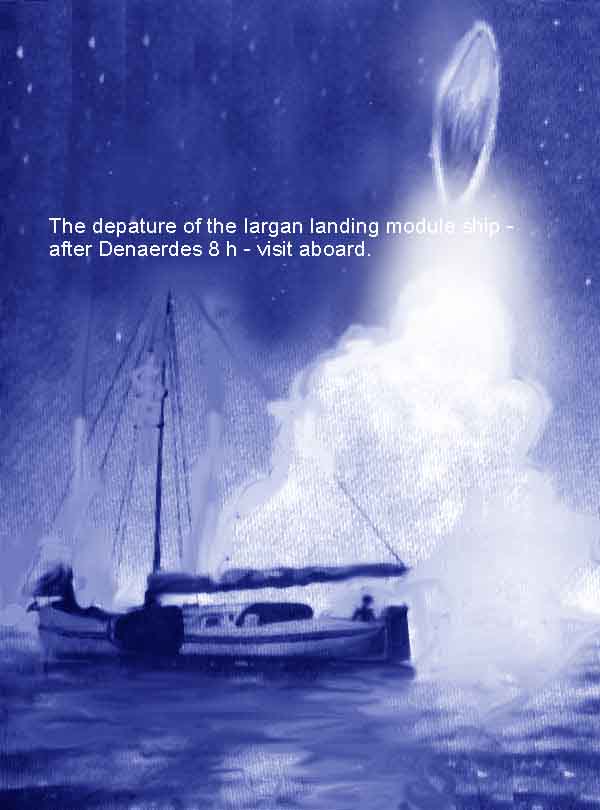
PUBLISHER'S NOTE:
The exact date and time of this first contact event are in fact known as well as other evidential support. There are other witnesses and there is material evidence supporting this story, but in keeping with the contactee's solemn promise never to try to PROVE the reality of the story or the actual existence of the Iargans, for very good reason, we have chosen not to reveal it. Wendelle C.Stevens
- PART II ON PHILOSOFY link
- apendix: understanding time
- other cosmic races
- main contact-page or here
- another site for part2 of the IARGA book
youtube video on how NATO found com. signals seemingly coming from the IARGA team
POWERPOINT ON THE CASE (and here norwegian ppoint) | czech translation (mirror)
Translation of Denaerde interview (or txt )part 1 on youtube | part2This interview was broadcasted on 19 August 1969, so it took place on that date or (probably) some weeks or months before that.
more on the case "The ultimate Theory Of Everything according to Stefan Denaerde "
hörbuch IARGA, deutch:
https://galactic.no/rune/lydboker/2020/H%c3%b6rbuch_Iarga_planeten